
Phoenix Consultants Group | Custom Computer Programming Phoenix Consultants Group | Custom Computer Programming
  • Custom Software Developers
    • Analyzing Business Needs
    • Custom Application Development
    • Data Collection and Management
    • Form Design & Development
    • Visual Basic Programming Experts
    • Custom Technology Products & Software Solutions for Business
  • .NET Development
    • Business Logic to .NET Architecture:
    • Smarter Decisions with Intelligent Data Systems
    • Custom .NET Software Development
  • Fireflight Data System
    • Fireflight – Project
  • Data Management
    • Managing Legacy Data and Systems
    • Conversion, Migration & Integration
    • Data Management
    • Data Movement & Middleware Integration Services
    • Enterprise Resource Planning
    • Inventory Management Systems
    • Microsoft Access Solutions
      • Access Database Consulting
      • Access Database Design
      • Access for Rapid Data Development
      • Access Database Programming
  • Case Studies
    • ISO 9000 Documentation & Regulatory Compliance Database
    • Superfund Soil Remediation
    • OSHA Training & Certification
    • Ground Water Monitoring
    • Pest Control Reporting Engine
    • Vineyard Pest Trap Management
    • Fueling System for a Top-5 U.S. Metro Fleet
    • Payroll System for a Multi-Facility Physician Staffing Company
    • Ground Support Equipment (GSE) Management System for Airport Operations
    • (MSDS/SDS) Management System
    • Pesticide Licensing Compliance System
    • EPA Title V Air Quality Management System
  • Tech Wisdom
  • Industries We Serve
    • Custom Software Portfolio
  • Blog
  • About Us
  • Contact Us
Phoenix Consultants Group | Custom Computer Programming
  • Custom Software Developers
    • Analyzing Business Needs
    • Custom Application Development
    • Data Collection and Management
    • Form Design & Development
    • Visual Basic Programming Experts
    • Custom Technology Products & Software Solutions for Business
  • .NET Development
    • Business Logic to .NET Architecture:
    • Smarter Decisions with Intelligent Data Systems
    • Custom .NET Software Development
  • Fireflight Data System
    • Fireflight – Project
  • Data Management
    • Managing Legacy Data and Systems
    • Conversion, Migration & Integration
    • Data Management
    • Data Movement & Middleware Integration Services
    • Enterprise Resource Planning
    • Inventory Management Systems
    • Microsoft Access Solutions
      • Access Database Consulting
      • Access Database Design
      • Access for Rapid Data Development
      • Access Database Programming
  • Case Studies
    • ISO 9000 Documentation & Regulatory Compliance Database
    • Superfund Soil Remediation
    • OSHA Training & Certification
    • Ground Water Monitoring
    • Pest Control Reporting Engine
    • Vineyard Pest Trap Management
    • Fueling System for a Top-5 U.S. Metro Fleet
    • Payroll System for a Multi-Facility Physician Staffing Company
    • Ground Support Equipment (GSE) Management System for Airport Operations
    • (MSDS/SDS) Management System
    • Pesticide Licensing Compliance System
    • EPA Title V Air Quality Management System
  • Tech Wisdom
  • Industries We Serve
    • Custom Software Portfolio
  • Blog
  • About Us
  • Contact Us

Tag: Growth Strategy

Last updated: October 2026
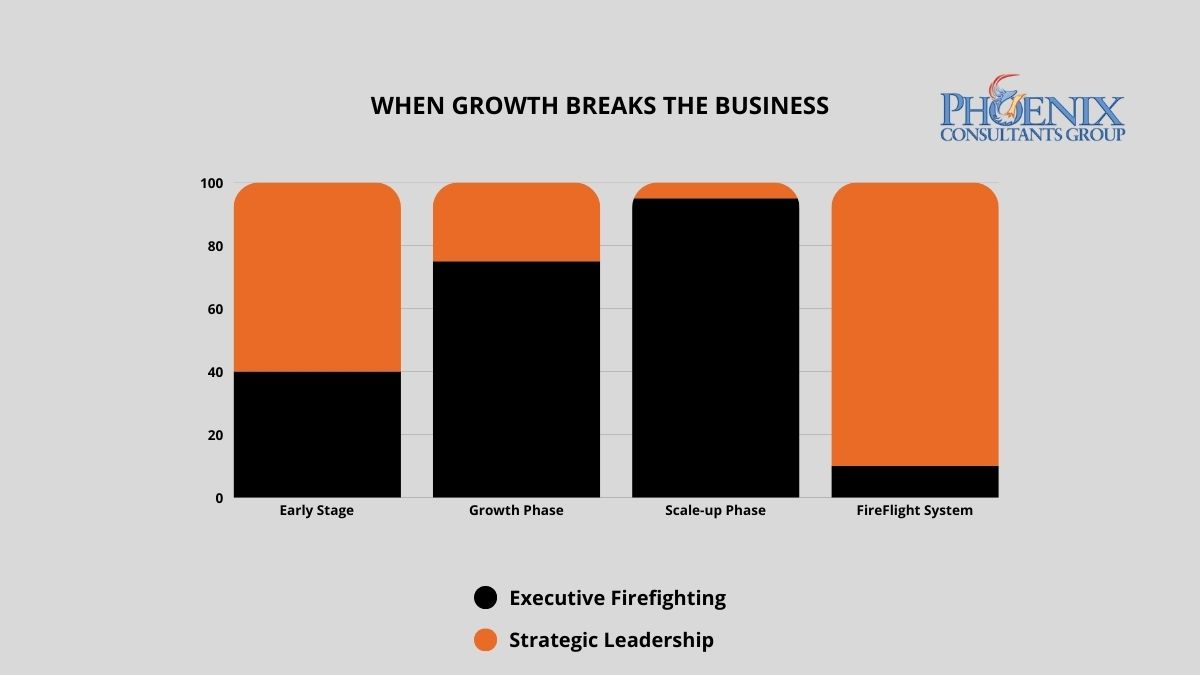
Chart showing the shift from operational firefighting to strategic leadership capacity as the underlying systems stabilize
When revenue doubles but the systems do not change, the business does not break loudly. It breaks by degrees, until the CEO is resolving system failures instead of leading. The cause is usually architectural, not a people problem: a stack of disconnected tools that held up at a smaller size and now cannot keep up. The fix is to unify the architecture, not to add one more piece of software to the pile.

Why does growth create chaos instead of momentum?

The pattern has a name worth knowing: architectural lag, where operational complexity outgrows the systems meant to carry it. A manual process that was fine at a million in revenue becomes a bottleneck a few times larger, and the primary constraint on the business not long after that. Nothing went wrong in the usual sense. The business simply outran the architecture it was built on, and every workaround added to keep going made the next stage harder to see.

This is where the broader market has landed too. In February 2026, Gartner described many older business systems as monolithic, for what it called their infamous inflexibility, and pointed to modern platforms that embrace modular composability as the way to add capability without a rebuild.1 The answer to a fragmented, overloaded stack is a single unified architecture, not another tool bolted onto the pile.

What does the cost of architectural lag look like at the leadership level?

The clearest measure is where the CEO's week goes. The more the architecture lags, the more executive time is spent inside the operation rather than ahead of it.

Operational stateWhere leadership time goesCapacity to lead strategically
Chaos: legacy or manual stackMost of the week resolving recurring failures and data mismatchesLow. The business runs the CEO.
Reactive: patchwork or partial ERPA large share of the week still goes to firefighting between systemsPartial. Strategy competes with crises.
Strategic: unified architectureLittle time on system failures; attention moves to planningHigh. Growth is no longer capped by the infrastructure.

A unified architecture does more than cut the number of fires. It removes many of the conditions that start them, so the shift is toward planning rather than reacting, and it tends to arrive not long after a full deployment settles in.

How do I know if the chaos is coming from my systems or my team?

If four or more of these five patterns describe your week, the growth ceiling is structural, and no amount of hiring will move it on its own.

  • The morning fire. The day starts by resolving the same category of system error or data mismatch, again.
  • The expansion hold. A market opportunity gets postponed because no one trusts the systems to carry the extra load.
  • The visibility gap. Basic operational questions, this month's margin, current inventory, billable hours, cannot be answered quickly.
  • The single-system dependency. One person is the only administrator of a system the business cannot run without.
  • The reconciliation meeting. Leadership spends its time reconciling conflicting numbers pulled from disconnected sources instead of deciding with them.

See what one unified architecture does to the week.

FireFlight is PCG's configurable platform that replaces the fragmented stack. Try it for 14 days, no obligation.

Start your 14-day free trial

What operational problems does a unified architecture address at each growth stage?

The symptom differs by sector, but the root is the same: data that has to be moved by hand between systems that do not talk to each other.

Manufacturing and industrial

Floor data, job costing, and inventory bridged to accounting by hand, so the numbers never quite agree.

Environmental and compliance

Permit, manifest, and inspection records that must hold a full audit trail across jurisdictions.

Healthcare staffing and multi-site

Scheduling, credentialing, and payroll accuracy that have to stay in step across every facility.

Fleet and field service

Dispatch, compliance, and billing data carried back from the field and re-entered by hand.

What does the move from operational chaos to architectural stability look like?

PCG runs it in three phases, in parallel with live operations so the business keeps running. The scope and schedule depend on the current stack and are set during the first phase, not promised in advance.

  1. System stress testA diagnostic that maps the manual steps, the conflicting data, and the person-dependent processes, ranked by how much leadership time each one consumes. Nothing changes in your systems during this phase.
  2. Architectural harmonizationFireFlight is deployed in parallel with live operations, migrating the data and resolving the friction points in sequence, so the business keeps working while the new architecture comes together underneath it.
  3. Strategic handoffLeadership moves to management by exception, with automated flags and a real-time executive dashboard, so attention goes to the few things that need a decision rather than the many that used to need a rescue. Your data stays yours throughout, in a standard format.
A CEO buried in system failures is not a leadership problem. It is an architecture that stopped fitting the company, and architecture is a thing you can change.

Start with a clear picture of where the time goes.

Run a 14-day free trial of FireFlight and see what a unified architecture takes off the CEO's plate.

Start your 14-day free trial

Frequently Asked Questions

Is the chaos coming from my systems or my team?+
If the same categories of error keep recurring regardless of who is on shift, the cause is usually the architecture, not the people. The system stress test is built to tell the two apart, by mapping where the failures actually originate before anyone proposes a change.
What happens to operations during the transition?+
The business keeps running. FireFlight is built and validated in parallel with the live systems, and the cutover is phased rather than a single switch, so day-to-day operations continue while the new architecture is put in place and checked against real data.
How quickly does the firefighting ease up?+
The recurring, system-generated fires ease as each friction point is resolved and automation takes over the routine handoffs. It is a steady reduction rather than a single moment, and the pace depends on how many of those points the stress test surfaces.
Can the platform scale if our business model changes?+
Yes. FireFlight is modular and built on standard .NET 10, so it is reconfigured rather than rebuilt when the model shifts. A new capability is added as a module without disturbing the rest, which is the point of a unified architecture over a fragmented stack.
How is this different from the systems that made things worse?+
Adding features to an already fragmented stack deepens the problem. FireFlight replaces the stack and re-encodes the business logic natively, so the data lives in one place instead of being copied between tools that each hold a slightly different version of the truth.
How long does deployment take?+
The stress test determines the timeline, because it depends on the current stack, the data to migrate, and how many friction points need resolving. The new system runs in parallel with the live one until the team approves a controlled go-live, so there is never a single risky switch.
About the Author

Allison Woolbert, CEO and Senior Systems Architect, Phoenix Consultants Group

Allison's experience in software development goes back to the early 1980s, predating PCG's founding in 1995. She has spent decades solving the hardest data problems in business, working with Fortune 500 corporations, growing mid-size firms, and small businesses across industries ranging from manufacturing and fleet management to healthcare staffing and regulatory compliance.

Her work includes mission-critical data systems built with corporations such as ExxonMobil, Nabisco, and AXA Financial, environments where information de-sync between operational units carries direct financial consequences. FireFlight Data System is the product of everything she learned: a unified, purpose-built engine designed to eliminate the structural failures she encountered and fixed throughout her career.

LinkedIn

1 Gartner, press release on embedded AI in cloud ERP applications, February 24, 2026, quoting Mike Helsel, Senior Director, Research, on legacy systems earning the descriptor "monolithic" for their inflexibility and on modern low-code flexibility and modular composability. gartner.com

2 Leadership time-allocation patterns reflect PCG pre-engagement assessments across mid-market operations.

This article is informational and not legal, financial, or technical advice for a specific situation. Whether a business's growth ceiling is structural, and what resolving it involves, depends on the particular operation and its systems; the system stress test exists to determine it. Phoenix Consultants Group has provided custom software development since 1995.
Recent Posts
  • You Know the Vendor Is Underperforming. You Just Can’t Prove It With Data.
  • Which Location Has It? Why Multi-Site Inventory Always Gives the Wrong Answer
  • Returns Don’t Manage Themselves. Here’s What Happens When Nobody Owns the Process.
  • Work Order Management Failures: The Real Cost
  • The Production Report Takes Longer to Build Than the Shift It Covers

Drop us a line! We are here to answer your questions 24/7

NEED A CONSULTATION?

Contact Us
Phoenix Consultants Group - Custom Computer Programming
Phoenix Consultants Group is a Minority Women and Veteran Owned business
LGBT-Owned

Copyright © 2021-2026. All Rights Reserved | Phoenix Consultants Group

Privacy Policy  |  Terms of Use  |  Legal  |  Security  |  Support
Solutions
  • Turning Ideas into Solutions
  • Smarter Decisions with Intelligent Data Systems
  • Custom .NET Software Development
  • Custom Application Development
  • Data Collection & Management
Data Management
  • Conversion, Migration & Integration
  • Custom Database Programming
  • Data Movement Services
  • Full Custom Data Management
  • Inventory Management Systems
Small Data Systems
  • Access Database Consulting
  • Access Database Design
  • Access Database Programming
Additional Services
  • Visual Basic Legacy Programming
  • Form Design & Development
Our Company
  • About Phoenix Consultants Group
  • Contact Us
  • Our Blog & News
  • Portfolio & Projects

Subscribe

Subscribe to our mailing list and you will always be updated with the latest news.

[newsletter_form type=”minimal”]

Phoenix Consultants FacebookPhoenix Consultants LinkedIn   Phoenix Consultants Instagram