
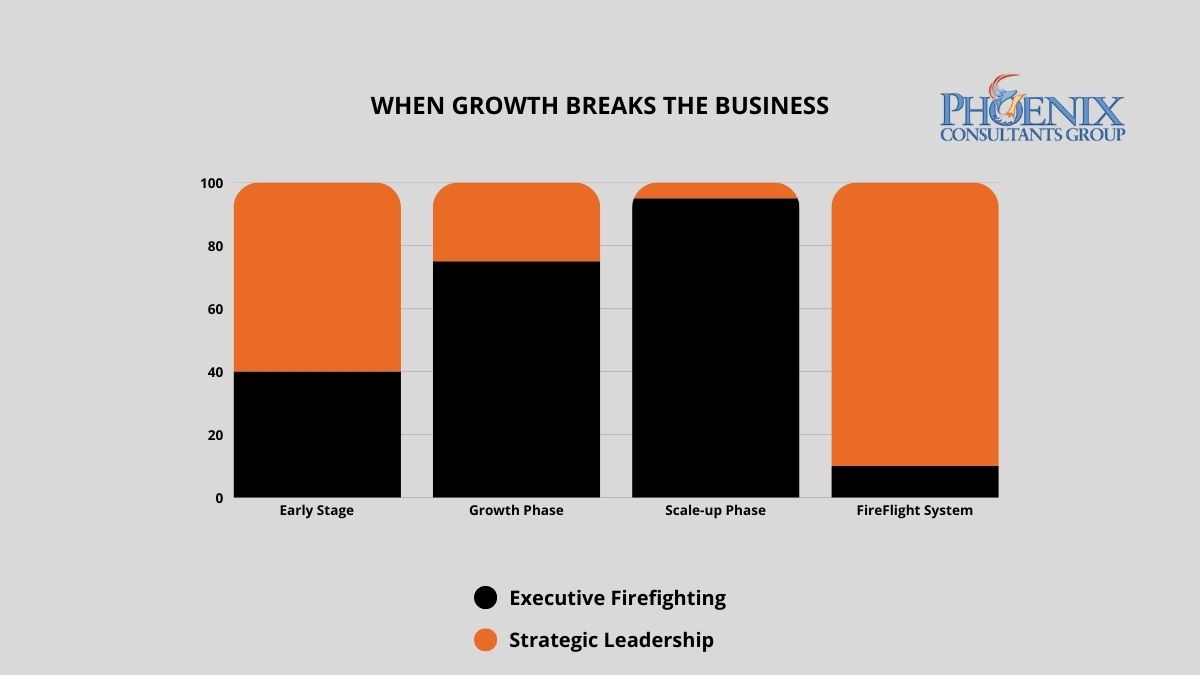
Why does growth create chaos instead of momentum?
The pattern has a name worth knowing: architectural lag, where operational complexity outgrows the systems meant to carry it. A manual process that was fine at a million in revenue becomes a bottleneck a few times larger, and the primary constraint on the business not long after that. Nothing went wrong in the usual sense. The business simply outran the architecture it was built on, and every workaround added to keep going made the next stage harder to see.
This is where the broader market has landed too. In February 2026, Gartner described many older business systems as monolithic, for what it called their infamous inflexibility, and pointed to modern platforms that embrace modular composability as the way to add capability without a rebuild.1 The answer to a fragmented, overloaded stack is a single unified architecture, not another tool bolted onto the pile.
What does the cost of architectural lag look like at the leadership level?
The clearest measure is where the CEO's week goes. The more the architecture lags, the more executive time is spent inside the operation rather than ahead of it.
| Operational state | Where leadership time goes | Capacity to lead strategically |
|---|---|---|
| Chaos: legacy or manual stack | Most of the week resolving recurring failures and data mismatches | Low. The business runs the CEO. |
| Reactive: patchwork or partial ERP | A large share of the week still goes to firefighting between systems | Partial. Strategy competes with crises. |
| Strategic: unified architecture | Little time on system failures; attention moves to planning | High. Growth is no longer capped by the infrastructure. |
A unified architecture does more than cut the number of fires. It removes many of the conditions that start them, so the shift is toward planning rather than reacting, and it tends to arrive not long after a full deployment settles in.
How do I know if the chaos is coming from my systems or my team?
If four or more of these five patterns describe your week, the growth ceiling is structural, and no amount of hiring will move it on its own.
- The morning fire. The day starts by resolving the same category of system error or data mismatch, again.
- The expansion hold. A market opportunity gets postponed because no one trusts the systems to carry the extra load.
- The visibility gap. Basic operational questions, this month's margin, current inventory, billable hours, cannot be answered quickly.
- The single-system dependency. One person is the only administrator of a system the business cannot run without.
- The reconciliation meeting. Leadership spends its time reconciling conflicting numbers pulled from disconnected sources instead of deciding with them.
See what one unified architecture does to the week.
FireFlight is PCG's configurable platform that replaces the fragmented stack. Try it for 14 days, no obligation.
What operational problems does a unified architecture address at each growth stage?
The symptom differs by sector, but the root is the same: data that has to be moved by hand between systems that do not talk to each other.
Manufacturing and industrial
Floor data, job costing, and inventory bridged to accounting by hand, so the numbers never quite agree.
Environmental and compliance
Permit, manifest, and inspection records that must hold a full audit trail across jurisdictions.
Healthcare staffing and multi-site
Scheduling, credentialing, and payroll accuracy that have to stay in step across every facility.
Fleet and field service
Dispatch, compliance, and billing data carried back from the field and re-entered by hand.
What does the move from operational chaos to architectural stability look like?
PCG runs it in three phases, in parallel with live operations so the business keeps running. The scope and schedule depend on the current stack and are set during the first phase, not promised in advance.
- System stress testA diagnostic that maps the manual steps, the conflicting data, and the person-dependent processes, ranked by how much leadership time each one consumes. Nothing changes in your systems during this phase.
- Architectural harmonizationFireFlight is deployed in parallel with live operations, migrating the data and resolving the friction points in sequence, so the business keeps working while the new architecture comes together underneath it.
- Strategic handoffLeadership moves to management by exception, with automated flags and a real-time executive dashboard, so attention goes to the few things that need a decision rather than the many that used to need a rescue. Your data stays yours throughout, in a standard format.
Start with a clear picture of where the time goes.
Run a 14-day free trial of FireFlight and see what a unified architecture takes off the CEO's plate.
Frequently Asked Questions
1 Gartner, press release on embedded AI in cloud ERP applications, February 24, 2026, quoting Mike Helsel, Senior Director, Research, on legacy systems earning the descriptor "monolithic" for their inflexibility and on modern low-code flexibility and modular composability. gartner.com
2 Leadership time-allocation patterns reflect PCG pre-engagement assessments across mid-market operations.
If you lead operations today, you are probably sitting on more data than ever and less clarity than you’d like to admit. Your team updates spreadsheets, your systems churn out reports, you get regular emails with attachments that promise “insights,” and yet you still find yourself asking the same question: “What is actually happening right […]