Last updated: April 2026

Unplanned IT downtime costs mid-size organizations between $5,000 and $9,000 per hour when the one person who understands the system is unavailable.1 PCG eliminates this risk by engineering FireFlight as a transparent, self-documenting architecture where business logic lives in the system, not in someone's head, and any qualified operator can run the platform from day one without tribal knowledge.

Why do organizations end up with systems only one person can operate?

The Expert Trap is almost never intentional. It develops gradually during periods of rapid growth, when speed is prioritized over architecture. A developer builds a workaround to solve an urgent problem. A power user creates a macro that automates a manual process. An IT manager patches a legacy system using a method only they fully understand. Each of these decisions makes sense in the moment. Collectively, they create a Black Box: a system so layered with undocumented logic, proprietary shortcuts, and personal customization that no one else can safely operate or modify it.

Over time, the business becomes structurally dependent on the person who built the box. IT leadership cannot modify the system without consulting them. Finance cannot run a custom report without their help. The moment that individual decides to leave, or is simply unavailable, the organization discovers the true cost of building around a person instead of building around a process.

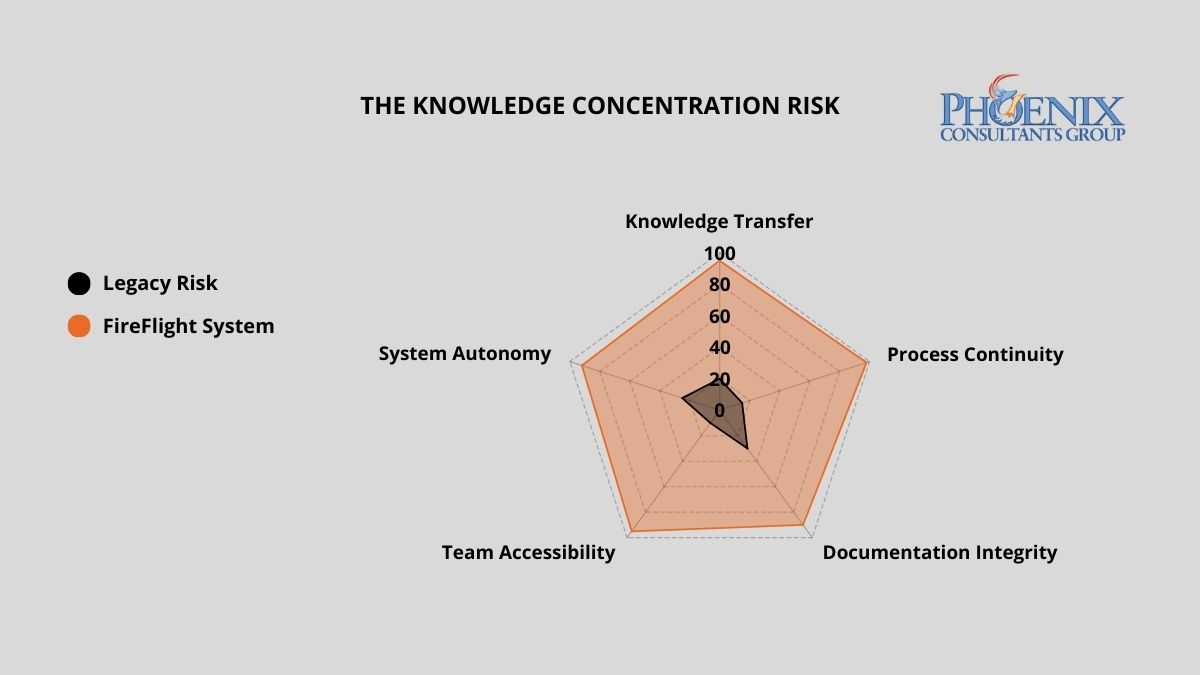
Radar chart comparing institutional resilience between a legacy key-man dependent architecture and FireFlight Data System across five dimensions: Knowledge Transfer, Process Continuity, Documentation, Team Accessibility, and System Autonomy. FireFlight scores at maximum across all five dimensions while the legacy model shows critical gaps in each.
Institutional resilience requires full coverage across all five dimensions simultaneously. A single gap in Knowledge Transfer or Process Continuity is sufficient to create an operational crisis when a key individual departs. FireFlight's transparent architecture is designed to close all five gaps by moving institutional knowledge from people into the system itself.

What does key-man dependency actually cost when it becomes a real incident?

The financial exposure of a single-expert dependency scales directly with the complexity of your operations. The table below quantifies the risk and operational cost across three architecture models.2

Architecture Model Weekly Hours Lost to Expert Bottlenecks Downtime Cost Per Incident Continuity Risk on Key Departure
Black Box: Undocumented Custom System 15–25 hrs $5K–$50K+ Total operational paralysis
Standard ERP: Documented, Generic 5–10 hrs $2K–$15K Significant downtime; retraining lag
FireFlight Transparent System < 1 hr Near zero Seamless: logic lives in the system

FireFlight shifts institutional knowledge from the individual to the architecture itself. Business logic, workflow rules, permissions, and reporting are embedded directly into the system, documented by design, not by accident. Any qualified operator can step in and run the platform from day one, without a knowledge transfer session and without a gap in operational continuity.

How do I know if my organization is already inside the Expert Trap?

Three markers indicate active key-man dependency. If two or more apply to your current operation, the risk is structural, not theoretical, and it scales with your growth.

The Key-Man Query

A critical system error occurs and your first instinct is to call a specific person, not a process, not a help desk, not a documented procedure. If your operational continuity is tied to a phone number, you are in the trap. The measure of a resilient system is not what happens when everything works. It is what happens when something breaks and the expert is on a plane.

The Manual Secret

Specific reports, data exports, or system functions require a sequence of undocumented steps that only one or two people know. When those people are unavailable, the function stops. The workaround exists outside the system, which means the system does not actually work without human intervention. Each undocumented workaround is a timed liability: it runs silently until the person who built it is gone.

The Update Fear

Your team avoids applying system updates, adding new users, or modifying existing workflows because no one is confident the changes will not break something. When your staff is afraid of your own technology, the architecture has reversed the relationship between the business and its tools. The system is running the organization rather than serving it.

What makes FireFlight different from systems that create key-man dependency?

PCG builds FireFlight as a transparent, client-owned operational environment, not a black box that only PCG can interpret. Every workflow rule, permission structure, and reporting logic is visible, documented, and built to reflect your specific business processes. Your team understands what the system does and why it does it.

That transparency is not a risk to PCG's business model. It is the foundation of it. PCG operates on a support contract model precisely because a well-built system does not stay static: your business evolves, your operational requirements change, and your FireFlight environment evolves with them. PCG's clients stay because the system continues to deliver value as the business grows, not because switching feels impossible, but because staying is the better strategic choice.

The underlying architecture, .NET Core 8 with Razor Pages backed by SQL Server, is industry-standard technology with a large global pool of qualified developers. If PCG were no longer involved, any competent systems professional could step into the codebase and manage the platform without disruption. That is not a hypothetical guarantee. It is an architectural fact built into every deployment.

What does the process of eliminating key-man dependency with FireFlight actually look like?

1
Dependency Audit

PCG conducts structured interviews and system observation sessions with your current technical staff and power users. Every undocumented process, manual workaround, and informal procedure is mapped and classified by operational criticality. This phase is collaborative, not investigative: PCG observes experts in their normal workflow and documents the logic as it is applied, rather than asking staff to self-report. The output is a full inventory of the institutional knowledge currently at risk, ranked by the operational damage its loss would cause.

2
Logic Extraction and System Encoding

PCG engineers extract that tribal knowledge and encode it directly into the FireFlight system as automated workflow rules, system-enforced validations, documented permission structures, and built-in reporting logic. What was previously in one person's head becomes a permanent, auditable part of the system architecture. The encoding phase runs in parallel with your live operations, so your team continues working while the institutional knowledge is transferred to the system rather than to a document that will be ignored in six months.

3
Knowledge Sovereignty Handoff

Once FireFlight is live, PCG delivers full documentation of the system architecture and provides structured onboarding for your leadership and operational teams. Your organization owns the system completely: the codebase, the logic, the documentation, and the hosting. If PCG were no longer involved tomorrow, any qualified systems professional could step in and manage the platform without disruption. That is not a contractual promise. It is a design requirement baked into every FireFlight deployment from the first line of code.

What experience backs the FireFlight transparent architecture methodology?

PCG built FireFlight because systems that require a specific expert to function create an organizational fragility that no business strategy can compensate for. Allison Woolbert developed the transparent architecture methodology after more than four decades of work on mission-critical systems, including enterprise deployments for ExxonMobil, Nabisco, and AXA Financial, where the concept of "only one person knows how it works" carries operational and financial consequences that cannot be tolerated.

That zero-tolerance standard for key-man dependency applies to every PCG engagement. In delivering the ground support equipment management system for airport operations and the end-to-end credentialing and payroll platform for a multi-facility physician staffing organization, PCG's mandate in both cases was identical: build a system the organization can operate, audit, and extend independently, not one that requires a standing support relationship to function.

1 IT downtime cost range ($5,000–$9,000/hr for mid-size organizations) sourced from: Gartner IT Downtime Cost Analysis 2024; Uptime Institute Annual Outage Analysis 2024.

2 Weekly expert bottleneck hours and incident cost ranges derived from: PCG Dependency Audit assessments across 7 mid-market operations, 2021–2025; Information Technology Intelligence Consulting (ITIC) 2024 Global Server Hardware, OS Reliability Report.

Frequently Asked Questions

FireFlight is built on .NET Core 8, SQL Server, and Razor Pages, industry-standard technology with a large global pool of qualified developers. PCG provides full source code, architecture documentation, and system handoff as a standard part of every engagement. You are not locked into PCG's support contract to keep your system operational. That is by design, not a concession.
PCG's dependency audit is structured as a collaborative process, not an interrogation. We observe experts in their normal workflow, ask process-mapping questions, and document the logic as we see it applied rather than asking staff to self-report. The objective is to make the system better, not replace the people who built it. In most cases, the experts themselves benefit from the extraction process because it removes the pressure of being the single point of failure for a system they are tired of owning alone.
For organizations with 3 to 5 identified key-man dependencies, the full audit and initial extraction phase typically runs 30 to 45 days. The FireFlight encoding phase runs in parallel with your live operations, so there is no downtime requirement during the transition. Your team continues working normally while the institutional knowledge is transferred from people to the system architecture.
No. Transparency in this context refers to the clarity of the system's logic and workflow, not open access to data. FireFlight operates on a granular, role-based permission system: every user's access is defined at the form level, the subrecord level, and the field level. Authorized users understand how the system works. Unauthorized users cannot access it at all. Security and architectural clarity are not in conflict. They are complementary properties that FireFlight enforces simultaneously.
The direct financial recovery comes from three sources: elimination of the productivity bottleneck created by expert-dependent tasks (typically 15 to 25 hours per week in Black Box environments), reduction of incident response costs when system issues occur (mid-size operations report $5,000 to $50,000 per unplanned IT downtime incident), and elimination of the negotiating leverage a departing expert holds over the business during transition. PCG quantifies your specific baseline during the dependency audit and projects recovery against a defined timeline.
The IT Key-Man Risk is the organizational condition where a single individual holds the institutional knowledge required to operate, modify, or repair a critical system. Industry data on unplanned IT downtime consistently places the cost between $5,000 and $9,000 per hour for mid-size organizations. That figure does not include the cost of decisions that cannot be made, orders that cannot be processed, or reporting cycles that stop while leadership waits for the one person who knows how to run a query.
FireFlight is built as a transparent, client-owned operational environment where every workflow rule, permission structure, and reporting logic is visible, documented, and built to reflect your specific business processes. Business logic lives in the system architecture, not in someone's head. Any qualified operator can run the platform from day one. PCG provides full source code, architecture documentation, and system handoff as a standard part of every engagement, not as an optional add-on.
About the Author Allison Woolbert, CEO and Senior Systems Architect, Phoenix Consultants Group

Allison's experience in software development goes back to the early 1980s, predating PCG's founding in 1995. She has spent decades solving the hardest data problems in business, working with Fortune 500 corporations, growing mid-size firms, and small businesses across industries ranging from manufacturing and fleet management to healthcare staffing and regulatory compliance.

Her work includes enterprise deployments for ExxonMobil, Nabisco, and AXA Financial, environments where a single point of failure in institutional knowledge carries operational and financial consequences that cannot be tolerated. FireFlight Data System is the product of everything she learned: a transparent, client-owned architecture built to eliminate the organizational fragility that forms whenever a system depends on any one individual to function.

PCG founded 1995. phxconsultants.com | fireflightdata.com