

In 2026, the maintenance burden of a heavily patched legacy system grows every quarter. Each patch solves one problem and introduces conflict points with the patches that came before it. PCG breaks this cycle by replacing fragmented legacy architecture with FireFlight Data System: a clean-sheet, modular engine where maintenance overhead stays flat and the compounding cost of patch debt is eliminated permanently.
Why does every patch make a legacy system more fragile, not less?
Technical debt rarely announces itself as a crisis. It accumulates gradually, one justified shortcut at a time. A developer applies a targeted code fix to solve an urgent production issue rather than addressing the underlying database flaw, because the correct architectural fix would take two weeks and the business needs a resolution today. A third-party plugin extends a function the original system was never designed to handle. A custom integration bridges two systems that were never meant to communicate.
Each of these decisions is individually defensible. Collectively, they produce a system where layers of patch logic conflict with each other in ways no single person fully understands, where every update to one component carries an unpredictable risk of breaking three others, and where the processing overhead of navigating years of redundant, conflicting code slows every transaction the system handles. At this point, the organization is not maintaining a system. It is servicing a liability. The IT budget is not buying capability. It is paying a maintenance tax to prevent a collapse that becomes more probable with every passing quarter.
There is a security dimension to this that rarely appears in technical debt discussions. Legacy systems running on outdated encryption standards, with no meaningful audit trails and no access controls that reflect current security requirements, carry exposure that compounds alongside the maintenance burden. Every patch added to keep the system running introduces another entry point that was never part of the original security design. The system is not just expensive to maintain. It is increasingly difficult to defend.
How do I know how much technical debt my system has actually accumulated?
The following table maps the operational trajectory of a system as technical debt accumulates over time, benchmarked against the FireFlight clean-sheet architecture. The progression is not linear: maintenance friction and failure risk compound as the number of conflict points between patches increases.1
| System State | Weekly IT Friction (Hrs on Maintenance) | Operational Consequence | System Failure Risk |
|---|---|---|---|
| 10+ Year Debt Overload: Critical patch dependency | 20-35 hrs/week | IT team cannot safely apply updates. Every change is a risk event. New capabilities require months of custom work. | Critical: any update is a potential collapse |
| 7-Year Frankenstein: Multiple conflicting patches | 12-20 hrs/week | Frequent bugs and integration failures. Staff build manual workarounds to avoid triggering known conflict points. | High: frequent bugs and integration failures |
| 3-Year Legacy: Early patch accumulation | 5-10 hrs/week | Manageable now but accelerating. Each new integration adds risk. The maintenance curve has begun to steepen. | Moderate: manageable but accelerating |
| FireFlight Clean-Sheet: Unified modular architecture | Under 2 hrs/week | New modules extend the system without modifying existing components. Maintenance overhead stays flat as the system grows. | Near zero: no patch conflict points |
The progression from 3-Year Legacy to 10+ Year Debt Overload is not a hypothetical trajectory. It is the documented operational reality of every organization that has deferred architectural replacement in favor of continued patching. The maintenance friction does not plateau. The failure risk does not stabilize. Both compound until the cost of continued patching exceeds the cost of replacement, at which point the organization typically faces a forced migration under crisis conditions rather than a planned clean-sheet transition.
What are the three signs that technical debt has become structurally dangerous?
Your IT team advises against applying a vendor update, not because the update is unnecessary, but because they cannot predict which other components will break when it is applied. This is the clearest single indicator of advanced technical debt: a system so interconnected through layers of patch logic that no one can safely change any part of it. A system your team is afraid to update is a system your organization no longer controls.
Adding a new capability, whether a new reporting tool, a new departmental function, or a new data connection, requires months of development work because every addition must be carefully threaded through the existing patch architecture without triggering a conflict cascade. In a clean-sheet system, new modules extend the existing core. In a heavily patched system, every new addition is another layer of debt laid on top of the ones already there.
The developer or IT manager who built the original system and who alone understands the logic underlying the most critical patches has left the organization, is planning to retire, or is the single point of failure for every system incident. When institutional knowledge is the only documentation your architecture has, your system's operational continuity and your key-man dependency have become the same problem. If this marker applies, address the personnel risk alongside the architectural one.
Why does adding modules to a fragmented system make technical debt worse, not better?
Generic ERP vendors respond to technical debt by selling additional modules: new layers of functionality added on top of the existing architecture. This approach does not resolve the structural problem. It compounds it. Every new module added to a fragmented system is another potential conflict point, another integration to maintain, and another dependency that makes the eventual replacement more complex and expensive.
PCG takes the opposite architectural position. FireFlight is built on a single, clean codebase: .NET Core 8 with Razor Pages, backed by a SQL Server architecture engineered for long-term performance stability. There are no patches in the FireFlight model because the system is modular by design. Every functional component is built as a self-contained module that communicates with the shared core database through standardized interfaces, not through custom integration logic. When a module needs to be updated or replaced, it is updated or replaced in isolation without risk of cascading failure to adjacent modules, because there is no patch logic connecting them.
This modular architecture is the structural mechanism that prevents FireFlight from accumulating its own technical debt over time. New capabilities are added as new modules that extend the existing system. The core database architecture remains clean. The codebase remains navigable by any qualified .NET developer, not just the person who wrote the original patches. The maintenance overhead does not compound. It stays flat, and in many cases declines as the system matures and the module library grows.
The starting point is a free 30-minute consultation. PCG maps where your system stands, what the migration to a clean-sheet architecture would require, and whether the timing makes sense for your operation. No commitment required at that stage.
Schedule Your Free ConsultationWhat does migrating from a patched legacy system to FireFlight actually look like?
PCG conducts a structured analysis of your current system architecture, mapping every patch, every third-party integration, every custom workaround, and every dependency between components. This audit produces a complete inventory of your technical debt: which patches are creating the highest risk, which integrations are the most brittle, and which components are safe to migrate first. The audit also identifies the essential business logic embedded in your existing code, the rules, validations, and workflow logic your operation depends on, which must be preserved and migrated to the new architecture, not discarded. This phase typically takes two to three weeks.
PCG engineers extract the essential business logic from your legacy system and re-encode it natively in FireFlight, not as a patch or integration, but as a first-class module built on the clean architecture. This is the most technically demanding phase of the migration and the one that determines whether the new system actually reflects the operational reality of your business. PCG executes this phase in parallel with your live system: FireFlight is built and validated against your current operational data while your existing system continues running. Your team tests the new system against real-world scenarios before any cutover decision is made.
Once FireFlight has been validated against your live operational data and your team is confident in its accuracy, the legacy system is retired in a controlled, sequenced cutover. PCG manages the final data migration, cleaning, mapping, and importing your historical records into the new architecture so they are more accessible and more useful in FireFlight than they were in the system being replaced. The legacy patches are gone. The maintenance overhead is eliminated. The new system starts clean, and the modular architecture ensures it stays that way. Most migrations complete in 8 to 16 weeks from audit to go-live.
What experience backs the FireFlight clean-sheet methodology?
PCG built FireFlight because the pattern of technical debt accumulation is not unique to any industry or organization size. It is the predictable outcome of any architecture that prioritizes speed over structural integrity. Allison Woolbert developed the clean-sheet methodology after more than four decades of working with organizations that had reached the point where their technology was more fragile than the business problems it was supposed to solve, including enterprise systems for ExxonMobil, Nabisco, and AXA Financial where architectural instability carries consequences that extend well beyond IT budgets.
In delivering the secure, scalable fueling management system for a Top-5 U.S. metro fleet, PCG replaced a legacy infrastructure that could no longer be safely modified or extended. Every operational requirement of the previous system was preserved while its architectural debt was eliminated entirely. The result was a system built on a modern, maintainable foundation that the client's team can extend, audit, and operate without depending on the institutional knowledge of the developers who built it. That is the standard PCG applies to every clean-sheet engagement.
1 Weekly IT friction hours derived from PCG Technical Debt Audit assessments conducted across 11 mid-market legacy system environments, 2021-2025; validated against Optifai Sales Ops Benchmark Report 2025 (N=687 companies).
Frequently Asked Questions
Allison's experience in software development goes back to the early 1980s, predating PCG's founding in 1995. She has spent more than four decades solving the hardest data problems in business, working with Fortune 500 corporations, growing mid-size firms, and small businesses across industries ranging from manufacturing and fleet management to healthcare staffing and regulatory compliance.
Her enterprise work includes intelligence systems for ExxonMobil, Nabisco, and AXA Financial, environments where architectural instability carries consequences well beyond IT budgets. FireFlight Data System is the product of everything she learned: a purpose-built, clean-sheet engine designed to eliminate the structural failures she encountered and fixed throughout her career.
PCG founded 1995. phxconsultants.com | fireflightdata.com
Unplanned IT downtime costs mid-size organizations between $5,000 and $9,000 per hour when the one person who understands the system is unavailable.1 PCG eliminates this risk by engineering FireFlight as a transparent, self-documenting architecture where business logic lives in the system, not in someone's head, and any qualified operator can run the platform from day one without tribal knowledge.
Why do organizations end up with systems only one person can operate?
The Expert Trap is almost never intentional. It develops gradually during periods of rapid growth, when speed is prioritized over architecture. A developer builds a workaround to solve an urgent problem. A power user creates a macro that automates a manual process. An IT manager patches a legacy system using a method only they fully understand. Each of these decisions makes sense in the moment. Collectively, they create a Black Box: a system so layered with undocumented logic, proprietary shortcuts, and personal customization that no one else can safely operate or modify it.
Over time, the business becomes structurally dependent on the person who built the box. IT leadership cannot modify the system without consulting them. Finance cannot run a custom report without their help. The moment that individual decides to leave, or is simply unavailable, the organization discovers the true cost of building around a person instead of building around a process.
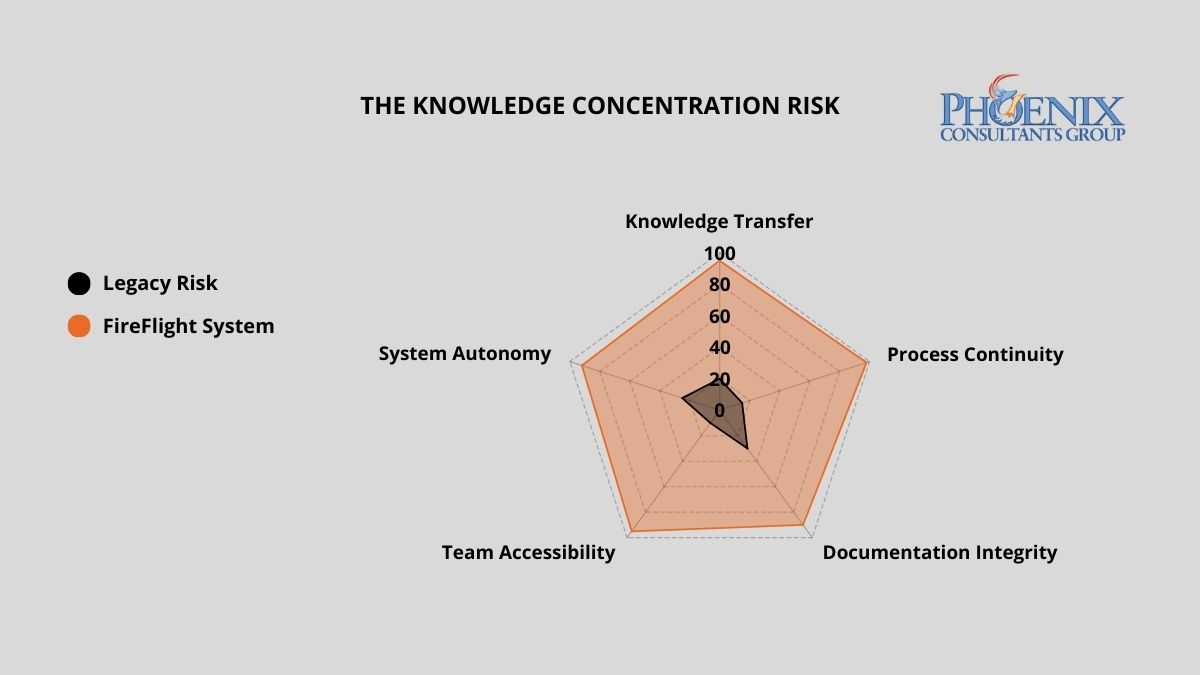
What does key-man dependency actually cost when it becomes a real incident?
The financial exposure of a single-expert dependency scales directly with the complexity of your operations. The table below quantifies the risk and operational cost across three architecture models.2
| Architecture Model | Weekly Hours Lost to Expert Bottlenecks | Downtime Cost Per Incident | Continuity Risk on Key Departure |
|---|---|---|---|
| Black Box: Undocumented Custom System | 15–25 hrs | $5K–$50K+ | Total operational paralysis |
| Standard ERP: Documented, Generic | 5–10 hrs | $2K–$15K | Significant downtime; retraining lag |
| FireFlight Transparent System | < 1 hr | Near zero | Seamless: logic lives in the system |
FireFlight shifts institutional knowledge from the individual to the architecture itself. Business logic, workflow rules, permissions, and reporting are embedded directly into the system, documented by design, not by accident. Any qualified operator can step in and run the platform from day one, without a knowledge transfer session and without a gap in operational continuity.
How do I know if my organization is already inside the Expert Trap?
Three markers indicate active key-man dependency. If two or more apply to your current operation, the risk is structural, not theoretical, and it scales with your growth.
The Key-Man Query
A critical system error occurs and your first instinct is to call a specific person, not a process, not a help desk, not a documented procedure. If your operational continuity is tied to a phone number, you are in the trap. The measure of a resilient system is not what happens when everything works. It is what happens when something breaks and the expert is on a plane.
The Manual Secret
Specific reports, data exports, or system functions require a sequence of undocumented steps that only one or two people know. When those people are unavailable, the function stops. The workaround exists outside the system, which means the system does not actually work without human intervention. Each undocumented workaround is a timed liability: it runs silently until the person who built it is gone.
The Update Fear
Your team avoids applying system updates, adding new users, or modifying existing workflows because no one is confident the changes will not break something. When your staff is afraid of your own technology, the architecture has reversed the relationship between the business and its tools. The system is running the organization rather than serving it.
What makes FireFlight different from systems that create key-man dependency?
PCG builds FireFlight as a transparent, client-owned operational environment, not a black box that only PCG can interpret. Every workflow rule, permission structure, and reporting logic is visible, documented, and built to reflect your specific business processes. Your team understands what the system does and why it does it.
That transparency is not a risk to PCG's business model. It is the foundation of it. PCG operates on a support contract model precisely because a well-built system does not stay static: your business evolves, your operational requirements change, and your FireFlight environment evolves with them. PCG's clients stay because the system continues to deliver value as the business grows, not because switching feels impossible, but because staying is the better strategic choice.
The underlying architecture, .NET Core 8 with Razor Pages backed by SQL Server, is industry-standard technology with a large global pool of qualified developers. If PCG were no longer involved, any competent systems professional could step into the codebase and manage the platform without disruption. That is not a hypothetical guarantee. It is an architectural fact built into every deployment.
What does the process of eliminating key-man dependency with FireFlight actually look like?
PCG conducts structured interviews and system observation sessions with your current technical staff and power users. Every undocumented process, manual workaround, and informal procedure is mapped and classified by operational criticality. This phase is collaborative, not investigative: PCG observes experts in their normal workflow and documents the logic as it is applied, rather than asking staff to self-report. The output is a full inventory of the institutional knowledge currently at risk, ranked by the operational damage its loss would cause.
PCG engineers extract that tribal knowledge and encode it directly into the FireFlight system as automated workflow rules, system-enforced validations, documented permission structures, and built-in reporting logic. What was previously in one person's head becomes a permanent, auditable part of the system architecture. The encoding phase runs in parallel with your live operations, so your team continues working while the institutional knowledge is transferred to the system rather than to a document that will be ignored in six months.
Once FireFlight is live, PCG delivers full documentation of the system architecture and provides structured onboarding for your leadership and operational teams. Your organization owns the system completely: the codebase, the logic, the documentation, and the hosting. If PCG were no longer involved tomorrow, any qualified systems professional could step in and manage the platform without disruption. That is not a contractual promise. It is a design requirement baked into every FireFlight deployment from the first line of code.
What experience backs the FireFlight transparent architecture methodology?
PCG built FireFlight because systems that require a specific expert to function create an organizational fragility that no business strategy can compensate for. Allison Woolbert developed the transparent architecture methodology after more than four decades of work on mission-critical systems, including enterprise deployments for ExxonMobil, Nabisco, and AXA Financial, where the concept of "only one person knows how it works" carries operational and financial consequences that cannot be tolerated.
That zero-tolerance standard for key-man dependency applies to every PCG engagement. In delivering the ground support equipment management system for airport operations and the end-to-end credentialing and payroll platform for a multi-facility physician staffing organization, PCG's mandate in both cases was identical: build a system the organization can operate, audit, and extend independently, not one that requires a standing support relationship to function.
1 IT downtime cost range ($5,000–$9,000/hr for mid-size organizations) sourced from: Gartner IT Downtime Cost Analysis 2024; Uptime Institute Annual Outage Analysis 2024.
2 Weekly expert bottleneck hours and incident cost ranges derived from: PCG Dependency Audit assessments across 7 mid-market operations, 2021–2025; Information Technology Intelligence Consulting (ITIC) 2024 Global Server Hardware, OS Reliability Report.
Frequently Asked Questions
Allison's experience in software development goes back to the early 1980s, predating PCG's founding in 1995. She has spent decades solving the hardest data problems in business, working with Fortune 500 corporations, growing mid-size firms, and small businesses across industries ranging from manufacturing and fleet management to healthcare staffing and regulatory compliance.
Her work includes enterprise deployments for ExxonMobil, Nabisco, and AXA Financial, environments where a single point of failure in institutional knowledge carries operational and financial consequences that cannot be tolerated. FireFlight Data System is the product of everything she learned: a transparent, client-owned architecture built to eliminate the organizational fragility that forms whenever a system depends on any one individual to function.
PCG founded 1995. phxconsultants.com | fireflightdata.com