

Phoenix Consultants Group | Custom Computer Programming Phoenix Consultants Group | Custom Computer Programming
  • Custom Software Developers
    • Analyzing Business Needs
    • Custom Application Development
    • Data Collection and Management
    • Form Design & Development
    • Visual Basic Programming Experts
    • Custom Technology Products & Software Solutions for Business
  • .NET Development
    • Business Logic to .NET Architecture:
    • Smarter Decisions with Intelligent Data Systems
    • Custom .NET Software Development
  • Fireflight Data System
    • Fireflight – Project
  • Data Management
    • Managing Legacy Data and Systems
    • Conversion, Migration & Integration
    • Data Management
    • Data Movement & Middleware Integration Services
    • Enterprise Resource Planning
    • Inventory Management Systems
    • Microsoft Access Solutions
      • Access Database Consulting
      • Access Database Design
      • Access for Rapid Data Development
      • Access Database Programming
  • Case Studies
    • ISO 9000 Documentation & Regulatory Compliance Database
    • Superfund Soil Remediation
    • OSHA Training & Certification
    • Ground Water Monitoring
    • Pest Control Reporting Engine
    • Vineyard Pest Trap Management
    • Fueling System for a Top-5 U.S. Metro Fleet
    • Payroll System for a Multi-Facility Physician Staffing Company
    • Ground Support Equipment (GSE) Management System for Airport Operations
    • (MSDS/SDS) Management System
    • Pesticide Licensing Compliance System
    • EPA Title V Air Quality Management System
  • Tech Wisdom
  • Industries We Serve
    • Custom Software Portfolio
  • Blog
  • About Us
  • Contact Us
Phoenix Consultants Group | Custom Computer Programming
  • Custom Software Developers
    • Analyzing Business Needs
    • Custom Application Development
    • Data Collection and Management
    • Form Design & Development
    • Visual Basic Programming Experts
    • Custom Technology Products & Software Solutions for Business
  • .NET Development
    • Business Logic to .NET Architecture:
    • Smarter Decisions with Intelligent Data Systems
    • Custom .NET Software Development
  • Fireflight Data System
    • Fireflight – Project
  • Data Management
    • Managing Legacy Data and Systems
    • Conversion, Migration & Integration
    • Data Management
    • Data Movement & Middleware Integration Services
    • Enterprise Resource Planning
    • Inventory Management Systems
    • Microsoft Access Solutions
      • Access Database Consulting
      • Access Database Design
      • Access for Rapid Data Development
      • Access Database Programming
  • Case Studies
    • ISO 9000 Documentation & Regulatory Compliance Database
    • Superfund Soil Remediation
    • OSHA Training & Certification
    • Ground Water Monitoring
    • Pest Control Reporting Engine
    • Vineyard Pest Trap Management
    • Fueling System for a Top-5 U.S. Metro Fleet
    • Payroll System for a Multi-Facility Physician Staffing Company
    • Ground Support Equipment (GSE) Management System for Airport Operations
    • (MSDS/SDS) Management System
    • Pesticide Licensing Compliance System
    • EPA Title V Air Quality Management System
  • Tech Wisdom
  • Industries We Serve
    • Custom Software Portfolio
  • Blog
  • About Us
  • Contact Us

Tag: Supply Chain

Operational Risk Operations & Process Improvement Uncategorized
A logistics coordinator talking on the phone while looking at a laptop and documents to resolve vendor performance management gaps.
_ July 9, 2026

You Know the Vendor Is Underperforming. You Just Can’t Prove It With Data.

Vendor performance management gaps cost more than a bad shipment. Here’s how to measure supplier performance before the next contract negotiation.

READ MORE
Data Management Inventory Systems
A data analyst working at a desk with two laptops and a spreadsheet, comparing regional stock levels to optimize multi-location inventory control.
_ July 7, 2026

Which Location Has It? Why Multi-Site Inventory Always Gives the Wrong Answer

Multi-location inventory control fails when every site has its own answer. Here’s where cross-location inventory visibility breaks and how to fix it.
READ MORE
Last updated: October 2026
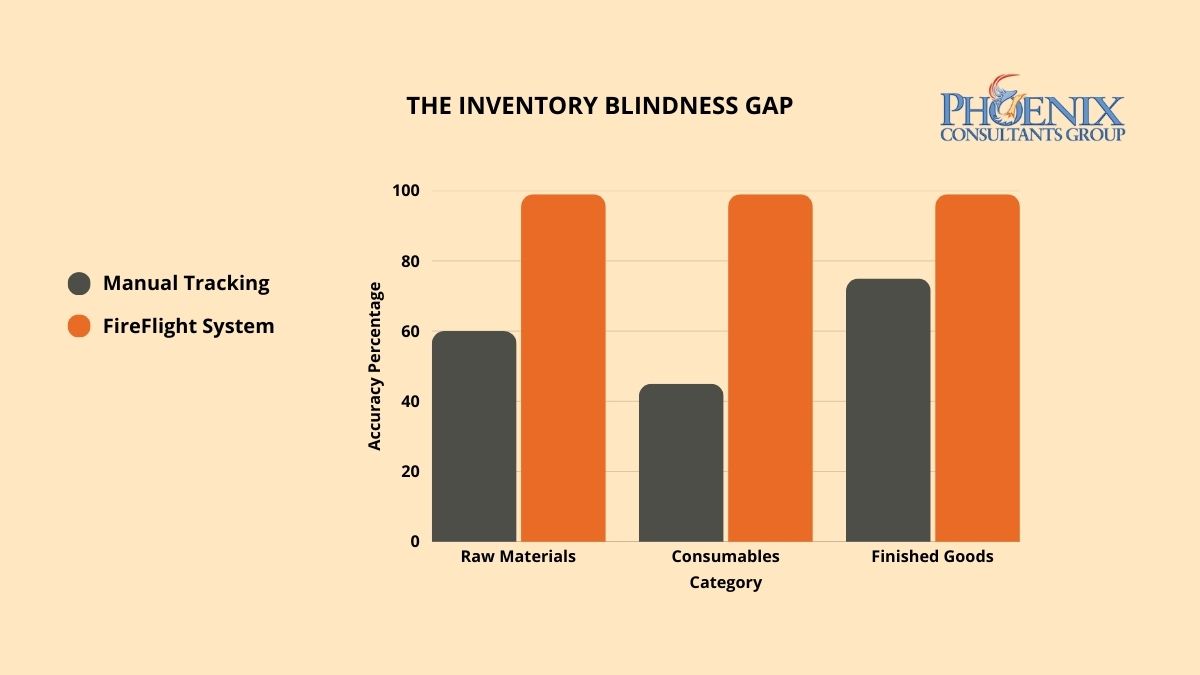
Bar chart illustrating the inventory blindness gap between legacy manual tracking and a real-time consumption-tracking architecture on the production floor
The system says 40 units, the floor says 12. That gap, ghost stock, is an architecture problem, not a counting problem. It appears because the system is updated in batches while material is consumed continuously, so the record and the shelf drift apart between counts. The fix is to capture consumption as it happens, so the recorded number and the physical count stay in step.

Why does ghost stock keep appearing in systems that are updated regularly?

Ghost stock is inventory the system still counts but the shelf no longer holds. It appears whenever the record is disconnected from the actual consumption events: a partial use, a remainder set aside, a return that never gets logged. Batch updates at the end of a shift, a day, or a month miss all of these, so a small variance opens up and then compounds. It starts as a minor gap, grows into a real one, and purchasers respond the only way they safely can, by overbuying buffer stock. Capital ties up in material nobody needs, and production still stops the day the true shortage is discovered.

In 2026 this carries a cost beyond the floor. Inaccurate inventory is a data-quality failure, and Gartner named poor data quality a leading direct cause of failed AI and analytics work this year.1 A business that cannot trust its stock numbers cannot build reliable forecasting, automated reordering, or AI on top of them, so the ghost-stock problem quietly caps everything it might do with its own data.

What does inventory inaccuracy actually do to operations?

The damage tracks how closely the record follows real consumption. The three states below describe where most operations sit.

Tracking stateTime lost to reconciliationProduction downtime risk
Blind: manual counts or spreadsheetsHigh. Staff hours go to counting and chasing variances.High. Several unplanned stops a month.
Standard: partial ERP, periodic countsModerate. Reconciliation at intervals, not at the transaction.Moderate. Occasional stops between counts.
Real-time: consumption captured as it happensMinimal. The record updates with the movement.Low. Reorder points trigger before depletion.

The move from the standard state to real-time is not an incremental gain. It closes the loop at the transaction level rather than at reconciliation, which is a different thing entirely: the gap never gets a chance to open, instead of being found and corrected after it already has.

How do I know if inventory blindness is costing my operation right now?

Three patterns show the problem is structural rather than occasional. Any one is worth watching; together they point to an architecture that cannot keep up.

The just-in-case overbuy

Buffer orders that reflect distrust of the system. Across the operation, that safety buying routinely costs more than fixing the root problem would.

The emergency production stop

An unplanned stop costs idle labor, expedited procurement, and a disrupted schedule. More than one a quarter is architectural, not bad luck.

The year-end write-off

The physical-count adjustment measures the gap between the system and reality. If it grows year over year, the errors are compounding, and counting more often will not fix it.

See inventory that updates with the work, not after it.

FireFlight is PCG's configurable platform, with real-time consumption tracking built in. Try it for 14 days, no obligation.

Start your 14-day free trial

Why do scanners and barcode systems alone not solve the inventory accuracy problem?

A scanner captures data. It does not, on its own, decide what that data means for the rest of the operation. The accuracy comes from what happens after the scan. Fed into the right system, a single scan updates the database, logs the production, adjusts quantities against the open job's bill of materials, recalculates the reorder point from current lead times, and raises a procurement alert, all in one transaction, as it happens.

That is the difference between capturing a number and keeping the record true. PCG's inventory module handles partial quantities, off-cuts, and returns, reconciles planned against actual consumption continuously, and runs on a SQL Server back end built to keep up with the many material movements a busy shift generates. The hidden cost of data silos covers the wider version of the same disconnect.

What does fixing inventory accuracy with FireFlight actually look like?

PCG runs it in three steps, alongside the existing process so the floor keeps moving. The scope and schedule depend on the operation and are set during the first step, not promised in advance.

  1. Material flow auditPCG maps material from receiving through to finished goods, classifies where the record and the reality diverge, and produces the data model the system will run on.
  2. Consumption logic integrationPCG configures the bill-of-materials, job-consumption, and lead-time rules, migrates and reconciles the historical data to an accurate baseline, and runs in parallel with the existing process before any cutover.
  3. Automated procurement handoffProcurement shifts to management by exception: the system generates purchase orders at the reorder thresholds and adjusts those thresholds as lead times change, so buyers act on exceptions rather than re-checking everything by hand.
More frequent counting measures the gap more often. It does not close it. Capturing consumption as it happens is what keeps the record and the rack in step.

Find out how wide your inventory gap really is.

Run a 14-day free trial of FireFlight and see what real-time consumption tracking does to the daily count.

Start your 14-day free trial

Frequently Asked Questions

Can the system track complex units like partial sheets, linear feet, or volume?+
Yes. It tracks in the operation's actual units, including fractions, off-cuts, and variable-unit materials, rather than forcing everything into whole pieces. That is often where ghost stock starts, because a partial use has nowhere to go in a simpler system.
How does reordering handle fluctuating supplier lead times?+
Reorder points recalculate automatically from current supplier data, accounting for the variability rather than a flat average. If a lead time moves from 5 days to 12, the threshold adjusts with it, so you are not reordering on a number that was true last quarter.
What happens to our existing records during migration?+
Records are imported, audited against physical counts, and reconciled to an accurate baseline before go-live, so the new system starts from the truth rather than carrying the old gap forward. Your data stays yours throughout, in a standard format.
Do we have to change our layout or labeling?+
Not necessarily. The system adapts to your existing layout, and any reorganization is your decision, not a precondition. The goal is to track what you already do accurately, not to make you rebuild the floor around the software.
How does it integrate with our suppliers?+
Custom API integration is available where a supplier supports it. Operations that prefer to keep a manual approval step can have purchase orders generated as drafts and routed to an approver rather than sent automatically, so the control stays where you want it.
How quickly does accuracy improve after deployment?+
The change is visible from the first full production cycle after go-live, because the system captures consumption as it occurs rather than waiting for a reconciliation. The gap stops widening immediately, and the baseline is already clean from the migration step.
About the Author

Allison Woolbert, CEO and Senior Systems Architect, Phoenix Consultants Group

Allison's experience in software development goes back to the early 1980s, predating PCG's founding in 1995. She has spent decades solving the hardest data problems in business, working with Fortune 500 corporations, growing mid-size firms, and small businesses across industries ranging from manufacturing and fleet management to healthcare staffing and regulatory compliance.

Her work includes mission-critical data systems built with corporations such as ExxonMobil, Nabisco, and AXA Financial, environments where information de-sync between operational units carries direct financial consequences. FireFlight Data System is the product of everything she learned: a unified, purpose-built engine designed to eliminate the structural failures she encountered and fixed throughout her career.

LinkedIn

1 Gartner, press release citing poor data quality or limited data availability as a leading direct cause of failed AI projects, April 7, 2026. gartner.com

2 Operational time-loss patterns reflect PCG material-flow audit assessments across manufacturing operations, consistent with industry distribution-center benchmarking by the Warehousing Education and Research Council (WERC).

This article is informational and not legal, financial, or technical advice for a specific situation. What inventory inaccuracy costs a given operation, and what fixing it involves, depends on the particular floor, materials, and systems; the material flow audit exists to determine it. Phoenix Consultants Group has provided custom software development since 1995.
Recent Posts
  • You Know the Vendor Is Underperforming. You Just Can’t Prove It With Data.
  • Which Location Has It? Why Multi-Site Inventory Always Gives the Wrong Answer
  • Returns Don’t Manage Themselves. Here’s What Happens When Nobody Owns the Process.
  • Work Order Management Failures: The Real Cost
  • The Production Report Takes Longer to Build Than the Shift It Covers

Drop us a line! We are here to answer your questions 24/7

NEED A CONSULTATION?

Contact Us
Phoenix Consultants Group - Custom Computer Programming
Phoenix Consultants Group is a Minority Women and Veteran Owned business
LGBT-Owned

Copyright © 2021-2026. All Rights Reserved | Phoenix Consultants Group

Privacy Policy  |  Terms of Use  |  Legal  |  Security  |  Support
Solutions
  • Turning Ideas into Solutions
  • Smarter Decisions with Intelligent Data Systems
  • Custom .NET Software Development
  • Custom Application Development
  • Data Collection & Management
Data Management
  • Conversion, Migration & Integration
  • Custom Database Programming
  • Data Movement Services
  • Full Custom Data Management
  • Inventory Management Systems
Small Data Systems
  • Access Database Consulting
  • Access Database Design
  • Access Database Programming
Additional Services
  • Visual Basic Legacy Programming
  • Form Design & Development
Our Company
  • About Phoenix Consultants Group
  • Contact Us
  • Our Blog & News
  • Portfolio & Projects

Subscribe

Subscribe to our mailing list and you will always be updated with the latest news.

[newsletter_form type=”minimal”]

Phoenix Consultants FacebookPhoenix Consultants LinkedIn   Phoenix Consultants Instagram