
Silent Margin Killer: An Executive Guide to Identifying and Closing Invisible Profit Leaks
Your revenue is up. Your team is working. And somehow, your margin keeps shrinking. This is not a sales problem or a pricing problem. It is a data problem and it is one of the most financially damaging conditions a growing business can face, precisely because it is invisible until the damage is already done.
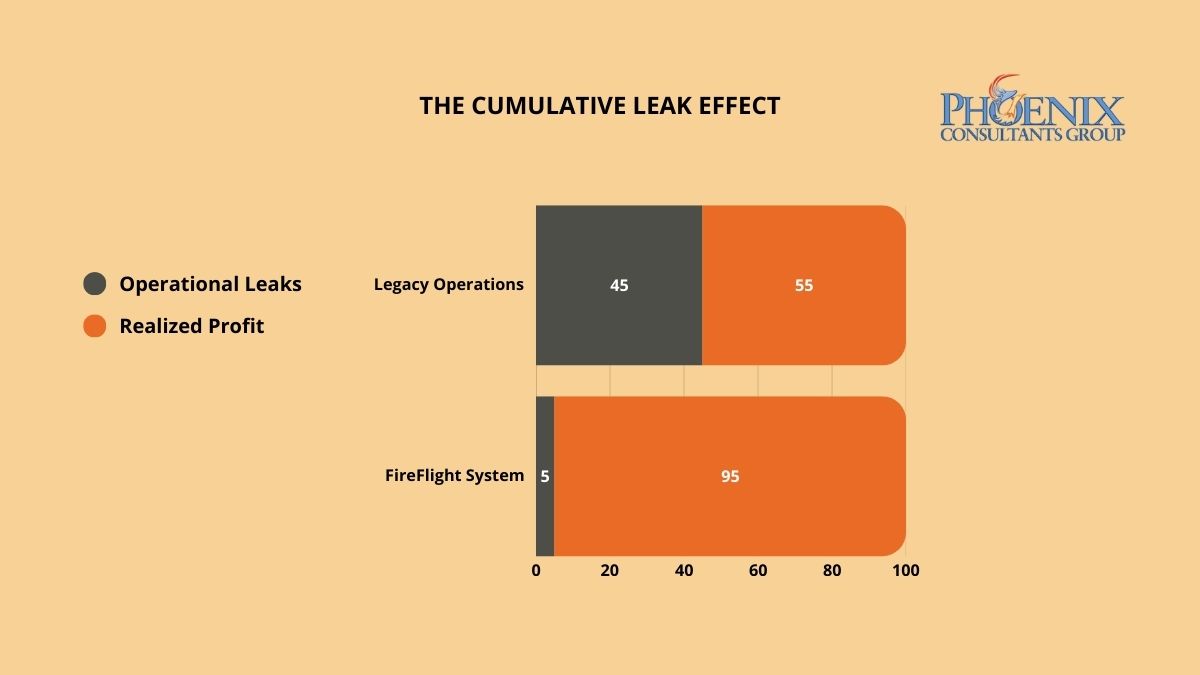
The phenomenon is called the Data Friction Tax: the cumulative financial loss generated by disconnected systems, manual reconciliation errors, untracked material consumption, and unbilled service hours. For a business generating $5 million in annual revenue, a conservative 5% friction tax represents $250,000 in margin that leaves the business every year without appearing as a single line-item expense. For a $20 million operation, that number exceeds $1 million quietly, consistently, across thousands of small transactions. Phoenix Consultants Group identifies these hidden loss centers through a rigorous Data Integrity Audit and deploys the FireFlight Data System to close them architecturally, so they cannot reopen.
Why Do Margins Bleed Out in Successful Companies?
Invisible profit leaks are not the result of bad management. They are the structural consequence of fragmented data architecture. When your production floor, warehouse, and accounting department operate on disconnected systems, small discrepancies compound across every transaction cycle. A 1% error in material waste. A 2% lag in labor tracking. A 1.5% leakage in unrecovered shipping and handling costs. Individually, each of these is below the threshold of a typical financial review. Collectively, they represent a consistent, systemic drain on liquidity that no amount of sales growth can fully compensate for.
The core problem is architectural: in a fragmented system, there is no mechanism that closes the loop between what was consumed, what was billed, and what was collected. Transactions flow through the organization through multiple disconnected platforms, and the gaps between those platforms the moments where data moves from one system to another through a manual step, a spreadsheet, or an informal process are precisely where the margin disappears. Without a unified framework that tracks every dollar from the initial quote to the final invoice, the friction tax is not a risk. It is a guarantee.
The Friction Tax Matrix: Quantifying the Invisible Leak
The following table maps the primary sources of data-driven margin loss against their financial impact and weekly operational cost, benchmarked against a $5 million annual revenue baseline and a FireFlight unified deployment.
Source of Friction | Weekly Friction (Hours Lost) | Annual Margin Impact | Est. Annual Leak at $5M Revenue |
Inventory Shrinkage & Ghost Stock | 6 – 10 hrs | 1.5% – 2.0% | $75K – $100K |
Manual Data Re-Entry & Reconciliation | 8 – 14 hrs | 1.0% – 1.5% | $50K – $75K |
Unbilled Labor & Service Hours | 4 – 8 hrs | 2.0% – 3.0% | $100K – $150K |
Unrecovered Shipping & Handling | 3 – 6 hrs | 0.5% – 1.0% | $25K – $50K |
FireFlight Integrity Framework – Closed Loop | < 1 hr | < 0.2% | Recaptured: $230K – $360K |
The final row represents the consolidated recapture potential for a $5 million revenue business after a full FireFlight deployment and Data Integrity Audit. This is not a projection based on optimistic assumptions it is a recovery of margin that was already being generated by the business and lost before it reached the bottom line.
The Strategic Friction Audit: Three Signs Your Data Is Costing You Money
Before quantifying the leak, executives need to confirm it exists. The following three indicators appear consistently in organizations where the friction tax is active. If two or more apply to your current operation, a formal Data Integrity Audit will identify the specific loss centers and their dollar value.
- The Growing ‘Miscellaneous’ Category: If your year-end adjustments, write-offs, or ‘other expense’ categories are growing faster than your revenue, you are not dealing with isolated accounting anomalies you are seeing the aggregate of hundreds of small data gaps that your current system cannot capture or categorize. This is the friction tax made visible only at the point of annual reconciliation, when the financial damage has already occurred.
- The Revenue-Labor Mismatch: If your team is logging more hours and your production volume is increasing, but your net margin is flat or declining, your system is failing to capture the full cost of production and translate it into billable output. This gap between what was consumed and what was invoiced is one of the most common and most costly forms of invisible leakage in service-based and manufacturing operations.
- The Revenue-Labor Mismatch: If your team is logging more hours and your production volume is increasing, but your net margin is flat or declining, your system is failing to capture the full cost of production and translate it into billable output. This gap between what was consumed and what was invoiced is one of the most common and most costly forms of invisible leakage in service-based and manufacturing operations.
Architecture Over Features: FireFlight as a Closed-Loop Integrity Engine
Generic ERP platforms are designed to be flexible and that flexibility is precisely what creates the leaks. When a system allows manual overrides, optional fields, and informal data entry pathways, it also allows the errors, omissions, and inconsistencies that generate the friction tax. User-friendly input does not guarantee data-accurate output.
Phoenix Consultants Group engineers FireFlight as a closed-loop integrity engine. The system enforces hard-coded validation rules at the point of data entry, using real-time field validation and contextual error prevention to ensure that data is captured correctly the first time not corrected manually at month-end. Role-based access controls at the form level and subrecord level mean that users can only interact with data they are authorized to modify, eliminating the informal workarounds that create ghost transactions and untracked consumption.
The SQL Server architecture underlying FireFlight is performance-tuned for high-volume transaction environments, with data compression and audit trail logging built into the core framework. This means that every material movement, every billable hour, and every shipping event is recorded, timestamped, and traceable from the moment it enters the system. There is no gap between operational reality and financial record the architecture enforces alignment between the two by design, not by policy.
The Continuity Roadmap: From Friction Tax to Recaptured Margin
Closing invisible profit leaks requires a structured audit before a single line of system configuration is written. PCG executes this process in three phases, with financial impact visible from the end of the first reporting cycle after deployment.
The Data Integrity Audit: PCG conducts a forensic analysis of your last twelve months of transactional data cross-referencing production records, inventory movements, labor logs, and invoicing cycles to identify the specific points where the numbers stop matching operational reality. This audit produces a quantified map of your current friction tax: every loss center, its dollar value, and the data gap that is generating it.
Closed-Loop Configuration: PCG configures the FireFlight system to enforce integrity at each identified loss center deploying automated validation rules, real-time consumption tracking, mandatory billing triggers for unbilled service events, and inventory reconciliation logic that flags discrepancies before they become write-offs. The system is configured to make the correct data entry path the only available path for each high-risk transaction type.
Real-Time Integrity Reporting: Once FireFlight is live, your leadership team gains access to a real-time integrity dashboard that tracks margin recapture against the audit baseline. Monthly financial statements reflect the recaptured liquidity directly, with full traceability to the specific architectural changes that prevented each category of loss. The friction tax does not gradually decline it stops at the point the closed-loop system goes live.
Evidence of Experience: Built for Financial Precision
PCG developed the Data Integrity Audit methodology because financial clarity cannot be achieved through accounting discipline alone it requires architectural enforcement. Allison Woolbert built this approach after three decades of overseeing complex data systems where untracked consumption and unreconciled transactions carried consequences measured in mission success, not just margin points including enterprise systems for ExxonMobil, Nabisco, and AXA Financial where data accuracy was a non-negotiable operational standard.
That same standard of architectural precision is applied to every PCG commercial engagement. In delivering the secure, scalable fueling system for a Top-5 U.S. metro fleet an environment where every gallon dispensed must be tracked, authorized, and reconciled against a financial record in real time PCG engineered the closed-loop integrity model that now underpins the FireFlight system. Zero untracked consumption. Zero reconciliation gaps. Zero friction tax.
Authority FAQ: C-Level Objections, Answered Directly
What if the audit uncovers systemic problems larger than we expected?
That is precisely the purpose of the audit. A larger-than-expected friction tax is not a failure of the audit process it is a confirmation that the investment in closing those leaks will generate a proportionally larger return. PCG scopes the FireFlight configuration to address the highest-impact loss centers first, delivering measurable margin recovery within the first reporting cycle while longer-tail issues are resolved in subsequent phases.
How does a Data Integrity Audit differ from a standard financial audit?
A financial audit confirms that your books are accurate according to what your system recorded. A Data Integrity Audit investigates whether what your system recorded reflects what actually happened operationally. The two are not the same. A financial audit can be clean while a friction tax is actively running because the system is accurately recording the wrong data. PCG’s audit identifies the gap between operational reality and financial record, which is invisible to standard accounting review.
Can the audit recover losses from historical periods?
The audit can identify patterns of loss from historical data going back twelve to twenty-four months, depending on the availability and completeness of your legacy records. While historical losses cannot be reversed, the pattern analysis allows PCG to build specific preventive logic into the FireFlight configuration ensuring that the same categories of loss cannot recur after the system goes live.
How quickly does margin recovery appear after FireFlight deployment?
The impact is architectural, which means it is immediate at the point of deployment. The friction tax stops at the moment the closed-loop validation rules go live not gradually as users adapt to new habits. The first monthly financial statement following a full FireFlight deployment will reflect the recaptured margin directly, with full traceability to the specific loss centers identified in the audit.
Is the friction tax a problem specific to manufacturing and inventory businesses?
No. Any organization that manages physical inventory, complex labor hours, high-volume transactions, or multi-stage billing cycles is exposed to the friction tax if their systems are architecturally fragmented. PCG has identified active friction tax conditions in service organizations, professional staffing firms, fleet management operations, and regulated compliance environments any business where data moves through more than one system before it becomes a financial record.
About the Author
Allison Woolbert: CEO & Senior Systems Architect, Phoenix Consultants Group
Allison brings over 40 years of expertise in database architecture, enterprise system design, and custom software development. She has spent four decades solving the hardest data problems in business working with Fortune 500 corporations, growing mid-size firms, and small businesses across industries ranging from manufacturing and fleet management to healthcare staffing and regulatory compliance. FireFlight Data System is the product of everything she learned: a purpose-built engine designed to eliminate the structural failures she encountered and fixed throughout her career.