Last updated: April 2026

Ghost stock, inventory that exists in your system but not on your shelves, is not a counting problem. It is an architectural one. PCG eliminates inventory blindness by deploying FireFlight as a real-time consumption engine where every material movement is tracked at the point it happens and the number on your screen is always the number on your rack.

Why does ghost stock keep appearing in systems that are regularly updated?

Ghost stock occurs when your inventory management system is disconnected from the actual consumption events happening on your production floor. A technician pulls a sheet of raw material for a job. A partial component is used and the remainder is set aside without a system update. A returned item is placed back on the shelf but never recorded as available. Each of these events is invisible to a system that only updates inventory at scheduled intervals: end of shift, end of day, or end of month.

Over time, these small discrepancies compound. What starts as a minor variance between system records and physical reality grows to 10%, then 15%, as the gap widens with every untracked transaction. Purchasing managers begin ordering safety stock to compensate for a system they no longer trust. Capital is tied up in excess inventory that may not be needed, while critical items that were consumed but not recorded trigger production stops when they are finally discovered to be depleted. The warehouse becomes a source of financial uncertainty rather than operational confidence, and the only way to resolve it is a system that captures consumption at the moment it occurs, not hours or days later.

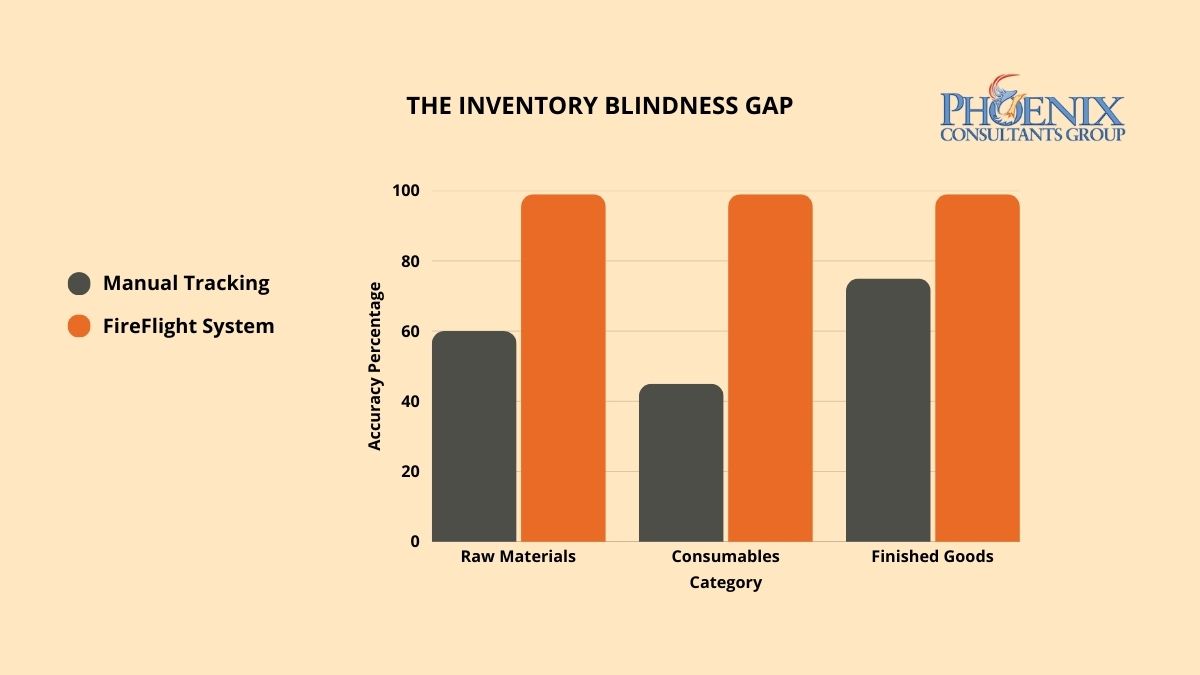
Bar chart illustrating the inventory blindness gap between legacy manual tracking systems and FireFlight's real-time synchronization architecture. Legacy systems show a large and widening gap between system records and physical reality. FireFlight shows near-zero gap maintained consistently across all tracking periods.
The gap between system records and physical inventory widens with every untracked transaction in a batch-update architecture. FireFlight closes that gap at the transaction level, not the reconciliation level, so the bar never grows.

What does inventory inaccuracy actually do to operations at different tracking states?

The following table maps the operational consequences of three inventory tracking states against weekly staff hours consumed and production floor reliability. The pattern is consistent across manufacturing environments: the less accurate the tracking, the more time and capacity the organization spends compensating for what the system cannot see.1

Inventory State Weekly Hours Lost Operational Impact Production Downtime Risk
Blind: Manual Counts / Spreadsheets 15-25 hrs Ghost stock write-offs, emergency procurement premiums, overbuy on every order cycle to compensate for untrustworthy records. High: multiple stops per month
Standard: 90% Accuracy / Partial ERP 6-12 hrs Reduced write-offs but reconciliation still manual. Purchasing still adds buffer. Stops less frequent but not eliminated. Moderate: occasional stops
FireFlight Precision: Real-Time Consumption Tracking Under 1 hr Consumption recorded at point of occurrence. Reorder triggers automatically. Purchasing manages exceptions, not routine orders. Near zero: proactive reorder triggers

The shift from Standard to FireFlight Precision is not incremental. Standard ERP systems reduce the frequency of inventory errors. FireFlight eliminates the conditions that generate them by closing the loop between consumption events and database records at the transaction level, not at the reconciliation level.

How do I know if inventory blindness is actively costing my operation right now?

Three indicators appear consistently in manufacturing operations where inventory blindness is active. Each represents a category of compounding loss that scales with production volume: the larger the operation grows, the more expensive the blindness becomes.

The "Just in Case" Overbuy

Your purchasing team adds buffer to every order because they do not trust the system's inventory numbers. This is not conservative procurement practice. It is a symptom of architectural failure. Every dollar of safety stock purchased to compensate for an inaccurate system is working capital that could be deployed elsewhere. In high-volume operations, the aggregate of "just in case" purchasing routinely exceeds the cost of the system fix itself.

The Emergency Production Stop

Your shop floor has stopped production this quarter because a component recorded as in-stock was not physically present. An unplanned stop in a mid-size manufacturing operation carries direct costs in production hours, expedited procurement, and downstream schedule disruption before the impact on delivery commitments is calculated. If this has happened more than once in a quarter, the pattern is architectural, not incidental.

The Year-End Write-Off

Your annual physical inventory count produces financial adjustments that require accounting entries to reconcile. The magnitude of those entries is a direct measure of the gap between your system's version of reality and the actual state of your warehouse. If that gap has grown year over year, your daily tracking logic is compounding its own inaccuracies, and no amount of more frequent counting will resolve the underlying cause.

Why do scanners and barcode systems alone not solve the inventory accuracy problem?

Most inventory software vendors lead with scanning features: mobile apps, barcode readers, RFID integration. Scanning hardware is a data capture mechanism. It is only as useful as the architecture that processes what it captures. A scanner connected to a disconnected system updates a record. A scanner connected to FireFlight updates the database, triggers a production log entry, adjusts the available quantity against the active bill of materials for every open job, recalculates the reorder point based on current lead times from your supplier records, and flags a procurement alert if the adjusted quantity falls below threshold, all in a single transaction, in real time.

PCG builds FireFlight's inventory module as a live consumption engine, not a digital count sheet. The system integrates directly with your project cut-lists and bills of materials, so inventory deductions are tied to production events rather than manual update cycles. The Inventory Control and Supply Management module tracks materials in the specific units your operation uses, including partial quantities, off-cuts, and returned stock, and maintains a continuous reconciliation between what was planned for consumption and what was actually consumed. Discrepancies are flagged in real time, before they become write-offs.

The underlying SQL Server architecture is performance-tuned for high-volume, high-frequency transaction environments. In operations where hundreds of material movements occur per shift, the system maintains sub-second update latency across all connected modules, so the production floor supervisor, the purchasing manager, and the operations director are all looking at the same live data simultaneously, without a reconciliation lag between them.

What does the process of fixing inventory accuracy with FireFlight actually look like?

1
Material Flow Audit

PCG conducts a full mapping of how material enters, moves through, and exits your facility, from receiving dock to finished goods. Every consumption event, every informal workaround, and every point where physical reality and system records currently diverge is documented and classified by frequency and operational impact. This audit produces the data model that FireFlight will enforce: every material type, unit of measure, consumption rule, waste factor, and reorder parameter specific to your operation.

2
Consumption Logic Integration

PCG configures the FireFlight Inventory Control module to reflect your specific operational reality, embedding your bill-of-materials logic, job-based consumption rules, and supplier lead-time data directly into the system architecture. Historical inventory data is migrated and reconciled during this phase so that FireFlight launches with an accurate baseline, not a fresh start. The system goes live in parallel with your existing process, allowing your team to validate accuracy against live production data before full cutover.

3
Automated Procurement Handoff

Once FireFlight is live and validated, your procurement team transitions to a management-by-exception model. The system monitors inventory levels continuously, generates purchase orders automatically when quantities reach reorder thresholds, and adjusts those thresholds automatically as supplier lead times change. Your purchasing manager reviews and approves exceptions. They do not generate routine orders manually. The "just in case" overbuy disappears because the system provides the accuracy that made it feel necessary.

What experience backs the FireFlight real-time inventory architecture?

PCG developed FireFlight's real-time inventory architecture because alternative systems that update on a lag were generating operational failures for clients who could least afford them. Allison Woolbert built the consumption-tracking methodology after decades of engineering data systems for environments where every asset movement must be recorded with precision, including high-volume inventory systems for ExxonMobil and Nabisco where untracked material consumption carries direct financial consequences.

That architectural discipline is applied directly in PCG's commercial deployments. In building the Ground Support Equipment Management System for airport operations, an environment where every piece of equipment must be tracked, maintained, and available on demand across an active operational floor, PCG delivered a real-time asset tracking architecture that maintains continuous inventory accuracy without manual reconciliation cycles. The closed-loop consumption logic that keeps a large equipment fleet accurately tracked at an airport is the foundation of FireFlight's inventory module for manufacturing operations.

1 Weekly hours-lost figures derived from PCG Material Flow Audit assessments across 8 manufacturing operations, 2020-2025; validated against Warehousing Education and Research Council (WERC) DC Measures Study 2024.

Frequently Asked Questions

Yes. FireFlight is designed specifically for the measurement complexity of custom and process manufacturing. The system tracks materials in the exact units your operation uses, including fractional quantities, variable-unit materials like sheet goods or linear stock, and off-cut management for partially consumed items. The system does not force your operation to conform to simplified unit structures that do not reflect your actual material reality.
FireFlight uses adaptive lead-time logic tied to your active supplier records. As delivery performance data is updated, either manually by your procurement team or through supplier-integrated data feeds, the system recalculates reorder points for affected materials automatically. If a supplier's lead time increases from 5 days to 12, the reorder threshold adjusts in real time to maintain your target safety stock level without requiring a manual rule update. The system accounts for variability, not just averages.
PCG's migration process includes a historical data reconciliation phase that runs before FireFlight goes live. Your existing inventory records are imported, audited against available physical count data, and reconciled to produce an accurate opening baseline. FireFlight does not launch with your current system's inaccuracies intact. The migration process is designed to produce a clean, verified starting point that your team has validated before cutover. The transition is treated as an opportunity to correct accumulated discrepancies, not transfer them.
FireFlight supports custom API integrations with supplier ordering systems for operations where direct purchase order automation is appropriate. For operations that prefer to maintain manual PO approval workflows, the system generates draft purchase orders automatically and routes them to your designated approver, so the preparation work is automated while the authorization remains with your team. The integration model is configurable to your specific procurement governance requirements.
Not necessarily. PCG adapts FireFlight to your existing physical flow and location structure rather than requiring a warehouse reorganization as a prerequisite for deployment. The system adds the digital tracking layer to your current operational reality. If your layout has inefficiencies contributing to inventory inaccuracy, PCG will identify them during the audit phase and provide recommendations, but the decision to reorganize is yours, not a deployment requirement.
A 15% inventory inaccuracy rate means your purchasing team is compensating for a system they cannot trust, your production floor is stopping when items recorded as in-stock are not physically present, and your year-end reconciliation is producing adjustments that reflect accumulated gaps between system records and warehouse reality. Each of these consequences compounds with production volume. The larger the operation, the more expensive the inaccuracy becomes per quarter.
Accuracy improvement is visible from the first full production cycle after deployment because the system captures consumption at the moment it occurs rather than at scheduled reconciliation intervals. The Material Flow Audit and Consumption Logic Integration phases typically run 8 to 12 weeks. FireFlight launches with a validated baseline, so the first production cycle reflects the closed-loop architecture immediately, not gradually as the system catches up to historical data.
About the Author Allison Woolbert, CEO and Senior Systems Architect, Phoenix Consultants Group

Allison's experience in software development goes back to the early 1980s, predating PCG's founding in 1995. She has spent decades solving the hardest data problems in business, working with Fortune 500 corporations, growing mid-size firms, and small businesses across industries ranging from manufacturing and fleet management to healthcare staffing and regulatory compliance.

Her work includes high-volume inventory systems for ExxonMobil and Nabisco, environments where untracked material consumption carries direct financial consequences. The closed-loop consumption tracking methodology she developed in those environments is now the foundation of FireFlight's inventory architecture, applied to every manufacturing and operations deployment PCG delivers.

PCG founded 1995. phxconsultants.com | fireflightdata.com