
Spreadsheet Trap: Ending the Manual Workaround Tax
Your operations manager has an MBA. Your senior accountant has fifteen years of industry experience. Your production coordinator ran a department twice this size at her last company. And right now, all three of them are in Excel, manually reconciling data that your ERP should have handled automatically. This is not a staffing problem. It is an architectural one, and it is one of the most expensive inefficiencies a growing organization can carry, precisely because it is invisible on the balance sheet.
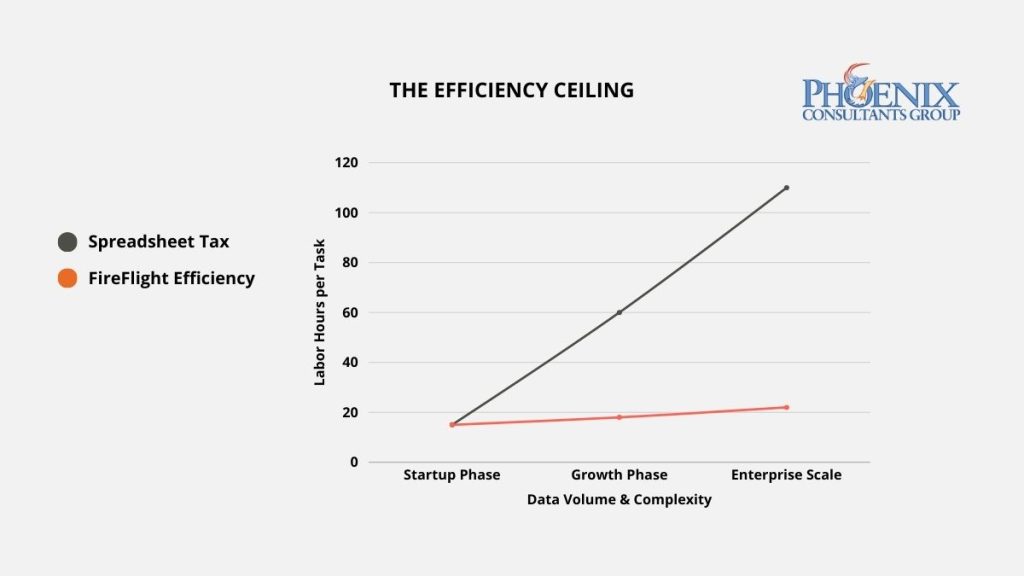
Industry benchmarks on manual data reconciliation consistently place the cost at $15 to $25 per hour of skilled employee time lost to workaround tasks the system should handle but cannot. For an organization where five employees at various seniority levels each spend 8 to 10 hours per week in manual reconciliation, the aggregate annual cost exceeds $190,000 in mis-allocated labor. That figure does not account for the compounding cost of the errors those manual processes introduce reconciliation mistakes that propagate through downstream reports, pricing calculations, and inventory records before anyone identifies and corrects them. Phoenix Consultants Group eliminates this waste by deploying the FireFlight Data System to automate the business logic that currently lives in your team’s spreadsheets so your people stop being human middleware and start doing the work you hired them to do.
Why Does 'Fixing' Data Become a Full-Time Job?
Manual workarounds do not appear by accident. They develop at the boundary between what a rigid system can do and what a fluid business process requires. When a legacy ERP cannot handle complex pricing tiers, multi-stage production workflows, or bespoke reporting logic, the team builds the missing capability in Excel because Excel is flexible, immediate, and does not require a development cycle to implement a new formula. This shadow system solves the immediate problem efficiently.
The long-term cost is structural. Because the Excel shadow system exists outside the official database, it has no real-time connection to the operational data it is supposed to reflect. Every time a transaction is processed in the ERP, someone must manually update the spreadsheet. Every time the spreadsheet is updated, there is a window during which the two versions of reality the ERP’s and the spreadsheet’s are out of sync. In high-transaction-volume environments, that window is permanent: the spreadsheet is always catching up to data that moved forward without it. The staff member responsible for maintaining it is not performing analysis or strategy. They are performing data maintenance a full-time job that generates zero operational value beyond keeping a workaround alive that should not exist.
The Manual Friction Loss Matrix: What Your Workaround Culture Is Costing
The following table quantifies the annual financial cost of manual data reconciliation at three employee seniority levels, benchmarked against a baseline of five employees per level spending the documented average number of hours per week on workaround tasks. The final row reflects the recapture potential after a full FireFlight automation deployment.
Employee Level | Avg. Hours Lost to Workarounds Weekly | Est. Annual Cost (5 Employees) | Primary Workaround Type |
Administrative / Data Entry | 10+ hrs/week | $35,000+ | CSV exports, manual re-entry, format conversion |
Middle Management / Operations | 8 hrs/week | $60,000 | Cross-system reconciliation, custom reporting |
Executive / Director | 4 hrs/week | $95,000 | Manual data aggregation for strategic decisions |
FireFlight | < 1 hr/week | Recaptured: $190,000+ annually | Automated validation, sync, and reporting |
The executive row generates the highest per-hour cost because it represents the most expensive misallocation: strategic decision-makers spending four hours per week manually aggregating data that a live dashboard should deliver in seconds. The total recapture figure $190,000 per year across five employees at each level represents operational capacity that is currently being consumed by a process the system should handle automatically.
The Strategic Friction Audit: Three Signs Your Business Is Running on Excel
These three operational markers indicate that manual workarounds have become structurally embedded in your business processes not as temporary fixes, but as load-bearing infrastructure. Each one carries its own category of compounding risk that grows with organizational size and transaction volume.
- The ‘Master’ Spreadsheet: Your business relies on a single, centralized Excel file or a small set of interconnected files that serves as the operational source of truth for a critical business function: pricing, inventory, scheduling, or financial reporting. Only one or two people know how to update it correctly. When that file breaks, the function it supports stops. This is the spreadsheet equivalent of the Expert Trap: a mission-critical dependency built on infrastructure that has no redundancy, no version control, and no audit trail. Note: the Expert Trap article in this series addresses the personnel risk dimension of this condition in detail.
- The Month-End Exhaustion: Your accounting or operations team works overtime at the end of every month specifically to reconcile data from multiple sources into a coherent financial picture. This overtime is not the result of unusual business volume it is the predictable cost of an architecture that cannot close its own books. Every month-end reconciliation cycle is a documented measure of how far your system’s version of operational reality diverges from what actually happened and how many hours of skilled labor it takes to bridge that gap manually.
- The Format Conversion Loop: Your team’s standard workflow includes downloading data from one system as a CSV, reformatting it in Excel, and re-uploading it to another system or using it to populate a report that should be generated automatically. This format conversion loop is data janitorial work: it produces no analytical value, introduces a manual error opportunity at every transfer step, and consumes hours of staff time that could be redirected to the analysis the data is supposed to enable. If it happens weekly, it is a structural problem. If it happens daily, it is a full-time position your architecture has created.
Architecture Over Features: Automation as a Foundation, Not a Feature
Generic ERP vendors offer macros, integrations, and automation add-ons as premium features. These tools automate individual tasks a specific export, a scheduled report, a data transfer between two connected systems. They do not address the structural problem: the underlying database logic is still producing data that requires human interpretation and correction before it is useful. PCG takes a fundamentally different approach.
FireFlight automates the logic that generates the data not just the tasks that move it around afterward. The system handles complex calculations, multi-variable pricing rules, cross-departmental validation logic, and bespoke reporting requirements natively within the system architecture. AI-assisted data entry and field validation prevent incorrect data from entering the system in the first place, eliminating the most common source of the reconciliation errors that drive manual workaround cycles. Real-time validation at the point of entry ensures that the data is correct at the source which means it does not need to be fixed at the destination.
For reporting specifically the function that generates the most intensive spreadsheet dependency in most organizations FireFlight provides three automation layers: canned reports that cover standard operational metrics without any manual assembly, filterable ad-hoc reporting tools for on-demand analysis, and user-personalized dashboards assembled from approved query libraries with permission-based visibility controls. Export to Excel, CSV, or PDF is available for downstream use cases, but the export is a deliberate choice, not a mandatory step in the reporting workflow. The goal is a system where the answer to any operational question is two clicks away not a 45-minute Excel session.
The Continuity Roadmap: From Manual Workaround to Automated Precision
Eliminating manual workarounds requires more than deploying a better system it requires extracting the business logic that currently lives in your team’s spreadsheets and encoding it permanently into the architecture. PCG executes this transition in three phases, with measurable workaround reduction beginning from the first automated reporting cycle after deployment.
- Friction Mapping and Logic Documentation: PCG conducts a structured audit of every manual workaround currently active in your organization documenting each spreadsheet, each format conversion loop, each manual reconciliation step, and the specific business logic embedded in each one. This includes the complex formulas, multi-condition rules, and exception-handling logic that your team has built into Excel over years of operational experience. The output of this phase is a complete inventory of the automation requirements for your FireFlight deployment: every rule that needs to be encoded, every calculation that needs to be automated, and every report that needs to be replaced with a live dashboard equivalent.
- Logic Extraction and System Encoding: PCG engineers extract the business logic from your documented spreadsheets and encode it natively into the FireFlight system not as a macro or an integration, but as first-class system architecture. Complex pricing calculations become automated validation rules. Multi-stage production workflows become system-enforced process flows. Custom reports become live dashboard views with real-time data. PCG validates each encoded rule against the original spreadsheet logic using historical operational data, confirming that FireFlight produces identical outputs to the manual process before the manual process is retired. Your team reviews and approves each automation before it goes live the transition is collaborative, not imposed.
- The Clean Workflow Handoff: Once FireFlight is live and your team has validated the automated outputs against their previous manual processes, the shadow systems are retired. Your staff enters data once at the point of origin, in the system and FireFlight executes the downstream logic automatically: the calculations, the cross-departmental updates, the report generation, the exception flagging. The month-end overtime disappears. The master spreadsheet is archived. The format conversion loop is replaced by a scheduled export or a live dashboard. Your operations manager goes back to managing operations. Your accountant goes back to financial strategy. Your production coordinator goes back to running production.
Evidence of Experience: Built to Replace the Shadow System
PCG developed FireFlight’s automation methodology because the shadow system problem complex business logic living in spreadsheets outside the official database was the most common and most costly architectural failure pattern Allison Woolbert encountered across three decades of enterprise system work. The pattern appears in every industry, at every company size, in every function: wherever a system cannot handle the complexity of the actual business process, a spreadsheet fills the gap. And wherever a spreadsheet fills the gap, a person’s time is consumed maintaining it.
The most direct application of this methodology in PCG’s commercial deployments is the end-to-end scheduling, credentialing, and payroll system for a multi-facility physician staffing organization an environment where scheduling logic, credential compliance calculations, and payroll rules are among the most complex calculation sets in any industry, and where those calculations were previously maintained in a combination of spreadsheets and manual processes across multiple facilities. PCG extracted that logic entirely, encoded it into the FireFlight system, and delivered a system where scheduling, credentialing, and payroll processing run automatically across all facilities with the operational team reviewing exceptions rather than building formulas.
Authority FAQ: Automation Objections, Answered Directly
How do we know the logic from our Excel spreadsheets was translated correctly into FireFlight?
Validation is a formal phase of the PCG deployment process, not an assumption. After each piece of spreadsheet logic is encoded into FireFlight, PCG runs the automated system against historical operational data and compares its outputs to the outputs the original spreadsheet would have produced for the same inputs. Discrepancies are identified, traced to their source in the encoding logic, and resolved before the automation goes live. Your team reviews and approves each validated automation before it replaces the manual process. The transition does not happen until both PCG and your operations team have confirmed that FireFlight produces the correct answer not just a plausible one.
What happens to our existing spreadsheets during the transition?
Your existing spreadsheets remain operational throughout the entire transition period. PCG’s deployment methodology runs FireFlight in parallel with your current manual processes your team continues using their spreadsheets while each automation is built, validated, and approved in FireFlight. The manual process is retired only after the FireFlight equivalent has been validated and accepted by the relevant team members. The transition is function by function, not a single cutover event which means your operations are never dependent on an untested automation at any point in the process.
What about the exceptions our spreadsheets handle manually that the ERP never could?
Exceptions are the most important part of the logic extraction phase. PCG’s friction mapping process specifically documents the exception-handling logic embedded in your spreadsheets the conditional rules, the edge cases, the overrides that your team built in because the system could not handle them natively. These are encoded into FireFlight as explicit system rules, not left as manual interventions. For genuine business exceptions situations where human judgment is the correct decision mechanism FireFlight is configured to flag those cases for review rather than attempting to automate them. The system handles the routine. Your team handles the exceptions. That is the correct division of labor.
Does automation reduce the control our team has over data and calculations?
Automation increases control it does not reduce it. Manual processes provide the illusion of control because a human is touching the data, but that human is also the primary source of error, inconsistency, and undocumented logic. FireFlight’s automated system enforces consistent validation rules across every transaction, maintains a full audit trail of every data entry and calculation, and makes the business logic visible and reviewable in the system architecture rather than embedded in a spreadsheet formula that no one else can read. The difference between manual control and automated control is the difference between a process that depends on a person’s attention and a process that depends on a system’s architecture.
Can FireFlight handle the specific complex formulas and pricing logic we have built in Excel?
Yes, and handling complex, bespoke business logic is precisely the use case FireFlight was designed for. Generic ERPs fail at complex pricing, multi-variable production calculations, and custom reporting because they are built for a standardized business model. FireFlight is a configurable system, not a standardized product which means the logic is built to match your specific business rules, not the other way around. If your pricing model has 47 variables and 12 conditional tiers, PCG encodes 47 variables and 12 conditional tiers. The complexity of the existing logic is not a constraint on the automation it is the specification.
About the Author
Allison Woolbert: CEO & Senior Systems Architect, Phoenix Consultants Group
Allison brings over 40 years of expertise in database architecture, enterprise system design, and custom software development. She has spent four decades solving the hardest data problems in business working with Fortune 500 corporations, growing mid-size firms, and small businesses across industries ranging from manufacturing and fleet management to healthcare staffing and regulatory compliance. FireFlight Data System is the product of everything she learned: a purpose-built engine designed to eliminate the structural failures she encountered and fixed throughout her career.