
True Cost of Technical Debt: An Executive Guide to Knowing When Patching Has Become More Expensive Than Replacing
Every patch your IT team applies to a legacy system solves one problem and creates two more. The fix works until the next update, the next integration request, or the next developer who inherits the code and discovers that the logic connecting three critical modules was written by someone who left the company four years ago and documented nothing. This is technical debt: the compounding interest on every architectural shortcut your organization has ever taken.
The financial cost is substantial and measurable. Industry analysis consistently places the annual maintenance burden of a heavily patched legacy system at 15–25% of total IT budget a figure that grows 8–12% per year as the system ages and the number of conflict points between patches increases. For a mid-size organization spending $500,000 annually on IT, that represents $75,000 to $125,000 per year in maintenance costs alone before a single new capability is added, before any system failure is factored in, and before the productivity loss from a system that slows down with every patch is calculated. Phoenix Consultants Group breaks this cycle by replacing the Frankenstein architecture with the FireFlight Data System: a clean-sheet, unified engine built from a singular codebase where every module is designed to communicate with the core from day one, and where the maintenance tax is eliminated permanently not deferred.
Why Does Technical Debt Become a Terminal Business Risk?
Technical debt rarely announces itself as a strategic crisis. It accumulates gradually, one justified shortcut at a time. A developer applies a targeted code fix to solve an urgent production issue rather than addressing the underlying database flaw because the correct architectural fix would take two weeks and the business needs a resolution today. A third-party plugin is added to extend a function the original system was never designed to handle. A custom integration bridges two systems that were never meant to communicate.
Each of these decisions is individually defensible. Collectively, they produce a system where layers of patch logic conflict with each other in ways no single person fully understands, where every update to one component carries an unpredictable risk of breaking three others, and where the processing overhead of navigating thousands of lines of redundant, conflicting code slows every transaction the system handles. At this stage, the organization is not maintaining a system it is servicing a liability. The IT budget is not buying capability. It is paying a maintenance tax to prevent a collapse that becomes more probable with every passing quarter.
The Technical Debt Cost Matrix: The Compounding Price of Patching
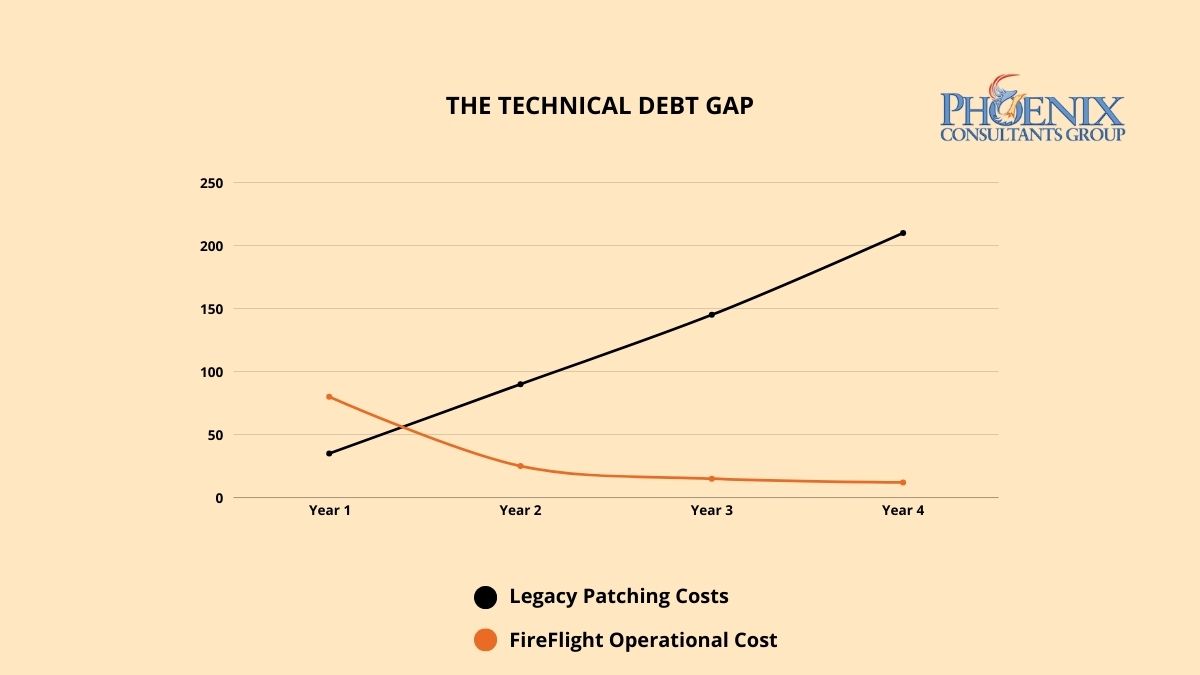
The following table maps the financial and operational trajectory of a system as technical debt accumulates over time, benchmarked against the FireFlight clean-sheet replacement. The progression is not linear maintenance cost and failure risk compound as the number of conflict points between patches increases.
System State | Weekly IT Friction (Hours on Maintenance & Firefighting) | Annual Maintenance Cost (% of IT Budget) | System Failure Risk |
10+ Year Debt Overload- Critical patch dependency | 20 – 35 hrs | 20% – 25% | Critical – any update is a potential collapse |
7-Year ‘Frankenstein’ -Multiple conflicting patches | 12 – 20 hrs | 15% – 20% | High – frequent bugs and integration failures |
3-Year Legacy – Early patch accumulation | 5 – 10 hrs | 8% – 15% | Moderate – manageable but accelerating |
FireFlight Clean-Sheet – Unified modular architecture | < 2 hrs | < 5% (optimized) | Near zero – no patch conflict points |
The progression from 3-Year Legacy to 10+ Year Debt Overload is not a hypothetical trajectory it is the documented operational reality of every organization that has chosen to defer architectural replacement in favor of continued patching. The maintenance cost does not plateau. The failure risk does not stabilize. Both compound year over year until the cost of continued patching exceeds the cost of replacement at which point the organization typically faces a forced migration under crisis conditions rather than a planned clean-sheet transition.
The Strategic Friction Audit: Three Signs Your System Is a Frankenstein
These three markers indicate that technical debt has crossed from manageable to structurally dangerous. Each one represents a category of compounding risk that accelerates with time the longer the organization waits to address it, the more expensive and complex the eventual resolution becomes.
The Update Fear: Your IT team advises against applying a vendor update not because the update is unnecessary, but because they cannot predict which other components will break when the update is applied. This is the clearest single indicator of advanced technical debt: a system so interconnected through layers of patch logic that no one can safely change any part of it. A system you are afraid to update is a system you no longer control.
The Integration Tax: Adding a new capability a new reporting tool, a new departmental function, a new data connection requires months of development work and significant budget to implement, because every addition must be carefully threaded through the existing patch architecture without triggering a conflict cascade. In a clean-sheet system, new modules extend the existing core. In a Frankenstein system, every new addition is another layer of debt.
The Vanishing Expert: The developer or IT manager who built the original system and who alone understands the logic underlying the most critical patches has left the organization, is planning to retire, or is the single point of failure for every system incident. When institutional knowledge is the only documentation your architecture has, the system’s operational continuity and your key-man dependency have become the same problem. Note: if this marker applies, the Expert Trap article in this series addresses the personnel risk dimension of this condition in detail.
Architecture Over Features: The Case for a Clean-Sheet Foundation
Generic ERP vendors respond to technical debt by selling additional modules new layers of functionality layered on top of the existing architecture. This approach does not resolve the structural problem. It compounds it. Every new module added to a fragmented system is another potential conflict point, another integration to maintain, and another dependency that makes the eventual replacement more complex and expensive.
Phoenix Consultants Group takes the opposite architectural position. FireFlight is built on a singular, clean codebase .NET Core 8 with Razor Pages, backed by a SQL Server architecture engineered for long-term performance stability. There are no patches in the FireFlight model because the system is modular by design: every functional component is built as a self-contained module that communicates with the shared core database through standardized interfaces, not through custom integration logic. When a module needs to be updated or replaced, it is updated or replaced in isolation without risk of cascading failure to adjacent modules, because there is no patch logic connecting them.
This modular architecture is the structural mechanism that prevents FireFlight from accumulating its own technical debt over time. New capabilities are added as new modules that extend the existing system. The core database architecture remains clean. The codebase remains navigable by any qualified .NET developer not just the person who wrote the original patches. The maintenance cost does not compound. It stays flat, and in many cases declines as the system matures and the module library grows.
The Continuity Roadmap: From Frankenstein to Clean-Sheet Without Operational Collapse
The most significant barrier to addressing technical debt is not the cost of replacement it is the fear that the replacement process itself will trigger the operational collapse the organization has been trying to prevent. PCG’s clean-sheet migration methodology is designed to eliminate that risk by making the transition gradual, parallel, and fully reversible at every stage until the final cutover.
The Technical Debt Audit: PCG conducts a structured analysis of your current system architecture mapping every patch, every third-party integration, every custom workaround, and every dependency between components. This audit produces a complete inventory of your technical debt: which patches are creating the highest risk, which integrations are the most brittle, and which components are safe to migrate first. Critically, the audit also identifies the essential business logic embedded in your existing code the rules, validations, and workflow logic that your operation depends on which must be preserved and migrated to the new architecture, not discarded.
Logic Extraction and Clean-Sheet Encoding: PCG engineers extract the essential business logic from your legacy system and re-encode it natively in the FireFlight system not as a patch or integration, but as a first-class module built on the clean architecture. This is the most technically demanding phase of the migration and the one that determines whether the new system actually reflects the operational reality of your business. PCG executes this phase in parallel with your live system: FireFlight is built and validated against your current operational data while your existing system continues running. Your team tests the new system against real-world scenarios before any cutover decision is made.
The Controlled Clean-Sheet Launch: Once FireFlight has been validated against your live operational data and your team is confident in its accuracy, the legacy system is retired in a controlled, sequenced cutover. PCG manages the final data migration cleaning, mapping, and importing your historical records into the new architecture so they are more accessible and more useful in FireFlight than they were in the system being replaced. The legacy patches are gone. The maintenance tax is eliminated. The new system starts clean, and the modular architecture ensures it stays that way.
Evidence of Experience: Built for Long-Term Architectural Integrity
PCG built FireFlight because the pattern of technical debt accumulation is not unique to any industry or organization size it is the predictable outcome of any architecture that prioritizes speed over structural integrity. Allison Woolbert developed the clean-sheet methodology after three decades of working with organizations that had reached the point where their technology was more fragile than the business problems it was supposed to solve, including enterprise systems for ExxonMobil, Nabisco, and AXA Financial where architectural instability carries consequences that extend well beyond IT budgets.
That same commitment to structural integrity drives PCG’s commercial deployments. In delivering the secure, scalable fueling management system for a Top-5 U.S. metro fleet replacing a legacy infrastructure that could no longer be safely modified or extended PCG executed a full clean-sheet migration that preserved every operational requirement of the previous system while eliminating its architectural debt entirely. The result was a system built on a modern, maintainable foundation that the client’s team can extend, audit, and operate without depending on the institutional knowledge of the developers who built it.
Authority FAQ: C-Level and CTO Objections, Answered Directly
At what point does patching become more expensive than replacing the system?
The crossover typically occurs between 18 and 36 months after the maintenance cost curve steepens which, in practical terms, means when the annual maintenance burden exceeds 18-20% of total IT budget and the frequency of patch-related incidents begins increasing quarter over quarter. PCG’s Technical Debt Audit quantifies your current position on this curve and projects the crossover point based on your system’s specific patch history and failure frequency. For most organizations that engage PCG, the audit confirms they have already passed the crossover and have been paying more to maintain than they would have spent on replacement.
How do we ensure the new system does not accumulate its own technical debt in 5 years?
This is the correct question, and the answer is architectural. FireFlight is built on a modular system where new capabilities are added as independent modules that communicate with the shared core through standardized interfaces not through custom integration logic. This structural design means there are no patch conflict points to accumulate. When a module needs updating, it is updated in isolation. When a new capability is needed, it is built as a new module that extends the existing system rather than modifying it. The maintenance cost stays flat because the architecture prevents the conditions that generate compounding debt.
What happens to our third-party integrations that depend on the legacy system?
PCG maps every third-party integration during the Technical Debt Audit phase and evaluates each one individually. Integrations that serve a genuine operational function are rebuilt natively within FireFlight using clean API architecture eliminating the brittle custom connectors that typically represent the highest-risk patch points in a legacy system. Integrations that were built to compensate for a limitation of the old system are evaluated for elimination rather than migration. In most cases, FireFlight’s native module library can handle the function directly, removing the need for the third-party dependency entirely.
Can we migrate to FireFlight without any operational downtime?
Yes. PCG’s migration methodology is designed specifically to avoid operational downtime. FireFlight is built, configured, and validated in parallel with your live legacy system your team continues operating on the existing infrastructure throughout the entire build and testing phase. The cutover is executed in a controlled, sequenced process during a low-activity window, with the legacy system available for rollback during an agreed validation period following go-live. The business does not stop. The transition is managed as an engineering problem, not an operational disruption.
How is our historical data handled during the migration?
PCG performs a complete data curation as part of the clean-sheet migration not a raw data dump from one system to another. Your historical records are cleaned, validated, and mapped to the new FireFlight data architecture before import. Data that was stored in inconsistent formats, fragmented across multiple tables, or compromised by historical patch errors is corrected during the migration process. The result is a historical record that is more complete, more consistent, and more queryable in FireFlight than it was in the legacy system being replaced.
About the Author
Allison Woolbert: CEO & Senior Systems Architect, Phoenix Consultants Group
Allison brings over 40 years of expertise in database architecture, enterprise system design, and custom software development. She has spent four decades solving the hardest data problems in business working with Fortune 500 corporations, growing mid-size firms, and small businesses across industries ranging from manufacturing and fleet management to healthcare staffing and regulatory compliance. FireFlight Data System is the product of everything she learned: a purpose-built engine designed to eliminate the structural failures she encountered and fixed throughout her career.