
When Growth Breaks the Business: The Architectural Fix That Frees the CEO to Lead
There is a specific inflection point in a company’s growth where the CEO stops building the business and starts managing the infrastructure. It happens gradually: a system error here, a manual reconciliation there, a reporting discrepancy that requires an emergency meeting to resolve. Before long, the majority of executive bandwidth is consumed by internal operational fires and the strategic decisions that should be driving market expansion are either delayed or made with incomplete information.
This is not a leadership failure. It is an architectural one. When a business scales past the capacity of its foundational systems continuing to manage $10 million in operational complexity with tools built for $1 million the structural cracks propagate upward until they reach the executive level. Research on mid-market leadership consistently shows that CEOs in operationally unstable environments spend 60-80% of their time on internal problem resolution, leaving less than a quarter of their capacity for the market-facing decisions that actually determine long-term growth. Phoenix Consultants Group eliminates this condition at the source, deploying the FireFlight Data System to build a self-sustaining operational infrastructure so the engine runs without the CEO having to run it.
Why Does Growth Produce Chaos Instead of Momentum?
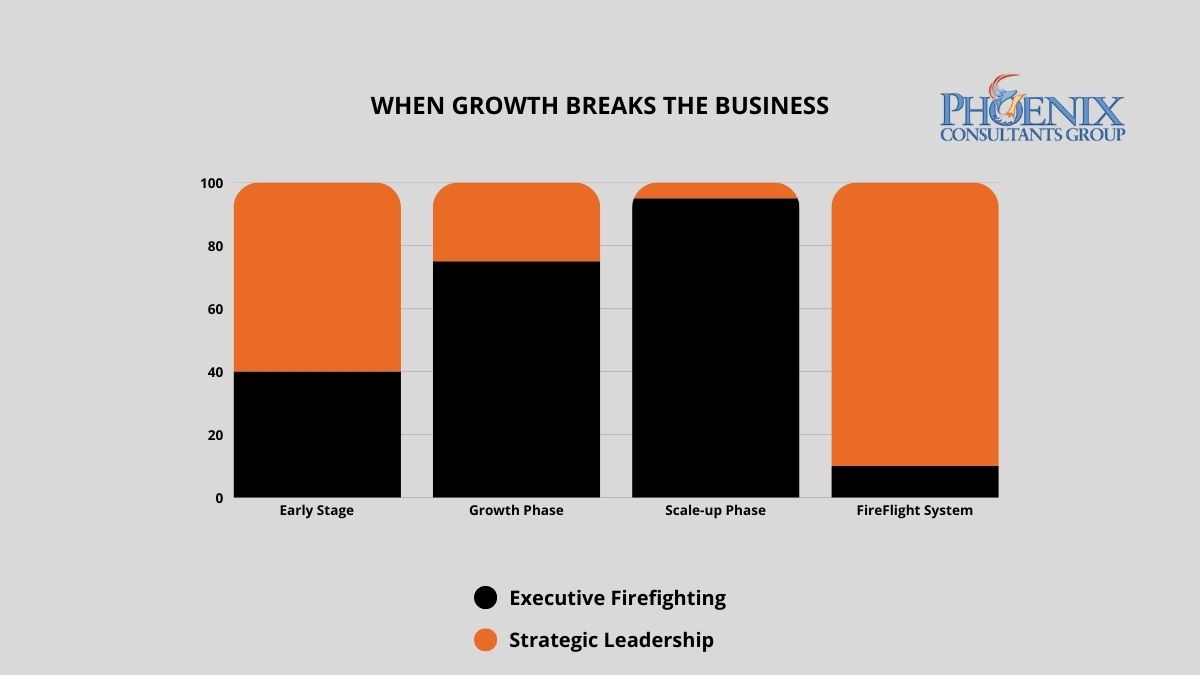
The answer is architectural lag the gap between the complexity your business has reached and the capability of the systems meant to support it. In the early stages of a company, manual processes and basic software are sufficient. The team is small, transaction volume is manageable, and the CEO is close enough to daily operations to catch errors before they cascade.
As the business scales, each of those manual processes becomes a bottleneck. Each disconnected system becomes a source of conflicting data. Each workaround becomes a dependency. The organization is now running a $10 million operation on infrastructure designed for $1 million and every incremental increase in volume makes the structural instability more pronounced. The result is not just inefficiency. It is a leadership trap: the CEO is forced to become a crisis manager, not because they lack strategic vision, but because the system demands constant human intervention to function at all. The business is no longer serving the CEO’s agenda. The CEO is serving the business’s dysfunction.
The Leadership Opportunity Cost Matrix
Operational chaos does not just consume executive time it has a direct, quantifiable impact on revenue growth, decision quality, and market responsiveness. The following table maps the relationship between infrastructure stability and executive output across three operational states.
Operational State | Weekly Internal Crisis Hours (Leadership) | Annual Revenue Growth Rate | Strategic Decision Capacity |
Chaos – Legacy/Manual Infrastructure | 25 – 35 hrs/week | 0% – 5% (stagnant) | < 20% of executive bandwidth |
Reactive – Patchwork / Partial ERP | 12 – 20 hrs/week | 5% – 12% (friction-constrained) | ~40% of executive bandwidth |
Strategic – FireFlight Unified Systems | < 3 hrs/week | Unconstrained by infrastructure | > 80% of executive bandwidth |
The FireFlight system does not just reduce the number of fires it eliminates the conditions that generate them. Automated cross-departmental sync, real-time validation at the point of data entry, and system-enforced workflow logic remove the manual intervention points that create the operational fires in the first place. The CEO is no longer the error-correction mechanism of last resort. The architecture handles that function.
The Strategic Friction Audit: Three Signs the System Is Running You
Operational chaos is often normalized by leadership teams who have managed within it for so long that it feels like the natural cost of running a business. These three markers distinguish structural system failure from ordinary operational complexity and if two or more apply, the constraint on your growth is architectural, not strategic.
The Morning Fire: Your first task every workday is resolving a system error, a data mismatch, or a departmental conflict generated by the previous day’s operations. This is not a management problem it is evidence that your system is producing errors faster than your team can resolve them. The correct fix is not faster resolution. It is architectural prevention.
The Expansion Delay: You have identified a market opportunity a new product line, a geographic expansion, an acquisition but you have postponed the decision because you do not trust your current system to handle the additional volume. When your technology is the primary constraint on your growth strategy, it has inverted its purpose. A system should expand your capacity, not define its ceiling.
The Decision Vacuum: You cannot answer a basic operational question current profitability by product line, real-time inventory position, outstanding billable hours without calling a meeting, waiting for a manual report, or pulling data from multiple sources and reconciling them yourself. Leadership without real-time operational visibility is reactive by definition. You are making strategic decisions on information that is days or weeks old.
Architecture Over Features: Building a Self-Sustaining Operational Infrastructure
Most productivity tools are designed to make individual tasks easier. They do not address the structural conditions that generate operational chaos because solving structural problems requires architectural intervention, not better task management.
Phoenix Consultants Group engineers FireFlight as a self-sustaining operational infrastructure. This means the system handles what currently requires human intervention: cross-departmental data synchronization runs automatically the moment a transaction is recorded; inventory positions update in real time without a nightly reconciliation job; billing triggers fire when service events are logged, without a manual review step. The FireFlight system eliminates the intervention points not just the errors they cause.
The technical foundation that makes this possible: FireFlight is built on .NET Core 8 with Razor Pages, backed by a SQL Server architecture that is performance-tuned for high-volume, multi-departmental transaction environments. Role-based access controls at the form and sub-record level enforce correct data entry without requiring supervisory review. The CEO’s role in the system is to review the exception report, not to generate it.
The Continuity Roadmap: From Operational Crisis to Strategic Clarity
Stabilizing an operationally chaotic environment requires a phased architectural intervention not a disruptive system replacement that creates a new crisis in the process of solving the existing one. PCG’s three-phase approach is designed to deliver measurable stability improvements at each stage, without requiring the business to stop operating while the transition takes place.
The System Stress Test: PCG conducts a structured audit of your current operational data flow mapping every point where manual intervention is required, every system that produces conflicting data, and every process that depends on a specific individual rather than an automated rule. This audit produces a ranked inventory of your highest-impact friction points, prioritized by the volume of leadership time they consume and the frequency with which they generate operational fires.
Architectural Harmonization: PCG deploys the FireFlight as the unified operational core for your business, migrating your existing data streams and configuring automated sync, validation, and reporting logic for each identified friction point. The deployment runs in parallel with your live operations your business does not stop while the new infrastructure is being built. Each friction point is resolved sequentially, delivering progressive relief from operational chaos during the transition period rather than at the end of it.
The Strategic Handoff: Once FireFlight is fully operational, your leadership team transitions to a management-by-exception model: the system flags anomalies and exceptions automatically; leadership reviews and acts on those flags rather than hunting for problems. A real-time executive dashboard provides operational visibility inventory position, revenue pipeline, labor utilization, billing status without a single manual report request. Your calendar opens. The fires stop. The strategic agenda resumes.
Evidence of Experience: Engineered for Operational Continuity Under Pressure
PCG built FireFlight because the CEOs and operations directors who needed architectural stability most were also the ones least able to tolerate a disruptive transition process. Allison Woolbert developed the system self-sustaining architecture methodology after three decades of engineering systems for environments where operational chaos was not just a productivity problem it was a mission risk. Her work includes enterprise deployments for ExxonMobil, Nabisco, and AXA Financial where operational stability directly determined business performance..
That same zero-tolerance standard for system-generated chaos is applied to every PCG commercial engagement. In building the secure, scalable fueling management system for a Top-5 U.S. metro fleet an operation that cannot stop, cannot tolerate manual reconciliation gaps, and cannot function with disconnected systems PCG delivered an architecture that runs without constant supervisory intervention. The operational team manages by exception. The system manages itself. That is the FireFlight model applied to commercial scale.
Authority FAQ: C-Level Objections, Answered Directly
How do I know the chaos is coming from my systems and not my team?
The clearest diagnostic is pattern analysis: if the same categories of errors recur regardless of which staff members are involved, the source is architectural. System-generated chaos is characterized by consistency the same type of reconciliation error, the same inventory discrepancy, the same reporting conflict because the system is producing the same structural failure repeatedly. Team-generated errors are more variable in type and location. PCG’s System Stress Test distinguishes between the two definitively within the audit phase.
What happens to our operations during the transition to FireFlight?
PCG’s deployment methodology is designed specifically to avoid creating a transition crisis. FireFlight is built and validated in parallel with your live operational systems your team continues operating on existing infrastructure while the new architecture is being configured and tested. The cutover to FireFlight is executed in a controlled, phased sequence, with each module validated against live data before your team transitions to it. The business does not stop. Operational continuity is maintained throughout.
How quickly does the firefighting actually stop after deployment?
The reduction is immediate and measurable from the first week of full deployment. Because FireFlight eliminates the intervention points not just the errors the volume of system-generated fires drops to near zero as soon as the automated validation and sync logic goes live. PCG tracks exception volume before and after deployment as part of the standard handoff process, so the leadership team has a quantified baseline comparison from day one.
Can FireFlight adapt if our business model or market strategy changes significantly?
Yes. Because FireFlight is a modular system built on standard .NET Core architecture, individual modules can be reconfigured, replaced, or extended without rebuilding the entire system. If you enter a new market, acquire a new business unit, or fundamentally change your service model, PCG can adapt the FireFlight configuration to the new operational reality without a system replacement. The architecture is designed to scale with your strategy, not to constrain it.
What is the first step for a CEO who recognizes this pattern in their organization?
The first step is a System Stress Test a structured audit of your current operational data flow that identifies exactly where the friction is originating, how much leadership time it is consuming, and what the architectural fix looks like. PCG conducts this audit as a defined engagement with a clear output: a prioritized map of your highest-impact friction points and a phased roadmap for resolving them. The audit itself does not require any changes to your current systems it is a diagnostic, not a deployment.
About the Author
Allison Woolbert: CEO & Senior Systems Architect, Phoenix Consultants Group
Allison brings over 40 years of expertise in database architecture, enterprise system design, and custom software development. She has spent four decades solving the hardest data problems in business working with Fortune 500 corporations, growing mid-size firms, and small businesses across industries ranging from manufacturing and fleet management to healthcare staffing and regulatory compliance. FireFlight Data System is the product of everything she learned: a purpose-built engine designed to eliminate the structural failures she encountered and fixed throughout her career.