Zero-Downtime ERP Migration: How to Replace a Business-Critical System While It Is Still Running
The scenario every executive dreads: you know your current system is failing. The maintenance costs are compounding, the scalability ceiling is real, and the security vulnerabilities are no longer theoretical. But the prospect of replacing it the data migration, the integration reconfiguration, the operational disruption feels more dangerous than the problem it would solve. So the decision gets deferred. Another quarter. Another year. Another round of emergency patches.
That deferred decision has a measurable cost. Research on enterprise technology adoption consistently shows that organizations running systems more than 5 years past their architectural replacement threshold lose between 15 and 30 percent of competitive responsiveness compared to peers operating on modern infrastructure not because of a single catastrophic failure, but through the cumulative drag of slower processes, higher maintenance overhead, and strategic decisions deferred because the system cannot support them. The fear of migration is rational. The cost of avoiding it is higher. Phoenix Consultants Group resolves this equation by treating ERP replacement the way cardiac surgeons treat a failing heart: as a procedure performed while the patient is fully operational, with zero tolerance for downtime and a validated outcome before the legacy system is ever retired. The FireFlight Data System is the architecture that makes that approach possible.
Why Is Software Migration Perceived as a Death Sentence?
Migration fear is not irrational it is grounded in documented industry failure rates. The Standish Group’s CHAOS Report, one of the most cited longitudinal studies of IT project outcomes, consistently finds that large-scale ERP implementations fail to meet their original objectives in more than 50% of cases, with the ‘Big Bang’ implementation model a complete system cutover executed over a compressed weekend window representing the highest-risk implementation approach in enterprise technology.
The mechanics of Big Bang failure are well understood: the old system is taken offline Friday evening, the new system is expected to go live by Monday morning. When data mapping errors surface at 2 a.m. Saturday, or a critical hardware integration fails during testing, or the data volume exceeds the import tool’s capacity, the organization wakes up Monday unable to process orders, ship product, or access financial records. Recovery from a failed Big Bang migration typically takes 2 to 6 weeks of parallel crisis management during which the business is operating at degraded capacity while simultaneously paying for emergency recovery work on the new system. The fear of this outcome is not what prevents migration. The absence of a credible alternative methodology is.
The Migration Risk Scorecard: Big Bang vs. PCG Zero-Downtime
The method of transition determines the risk profile of the entire engagement. The following table contrasts the documented outcomes of the traditional Big Bang implementation model against PCG’s parallel deployment methodology across five critical risk dimensions.
Risk Dimension | Traditional ‘Big Bang’ Implementation | PCG Zero-Downtime (FireFlight) |
Operational Downtime | 24 – 72+ hours (planned); weeks if recovery required | Zero minutes – business continues throughout |
Data Integrity on Go-Live | Manual reconciliation post-cutover; error rate typically 5-15% | Automated curation with live validation before cutover |
Implementation Failure Rate | ~50-70% fail to meet original scope (Standish Group) | Validated against live data before switch – no go-live until proven |
Staff Transition Stress | Extreme – single high-stakes cutover event | Controlled – phased learning with legacy system as safety net |
Rollback Capability | Typically none – old system decommissioned at cutover | Full rollback available until PCG and client validate final cutover |
The failure rate differential is not a reflection of PCG’s experience versus a generic vendor’s it is a reflection of methodology. Big Bang implementations fail at high rates because the approach compresses all risk into a single unrecoverable moment. PCG’s parallel deployment model distributes risk across a validation period and eliminates the unrecoverable moment entirely: the legacy system does not go offline until the new system has already been proven accurate against live operational data.
The Strategic Friction Audit: Three Signs the Cost of Staying Has Exceeded the Cost of Moving
Migration fear is most dangerous when it causes an organization to remain on a failing system past the point where the ongoing cost of that system exceeds the cost of replacing it. These three markers indicate that threshold has been crossed and that continued hesitation is the more expensive choice.
The Maintenance Sinkhole: Your annual IT maintenance and emergency patch budget for the legacy system exceeds what a modern replacement would cost on a subscription or deployment basis. This crossover is the clearest financial signal that inertia has become the more expensive strategy. If your team is spending more to keep a broken system alive than a functioning replacement would cost, the fear of migration is generating a direct, measurable annual loss.
The Scalability Ceiling: You have declined a new contract, postponed a market expansion, or limited your sales pipeline because you know your current system cannot handle the additional volume. When your technology determines the ceiling on your revenue growth, the cost of the system is not just its maintenance budget it is every dollar of growth opportunity it has prevented you from capturing.
The Security Exposure: Your legacy system has not received a security update from its original vendor in more than 12 months, or it relies on components operating systems, database versions, integration middleware that are no longer supported by their manufacturers. Unsupported legacy infrastructure is the primary attack vector for ransomware in mid-size enterprises. The cost of a ransomware incident recovery, downtime, data loss, regulatory exposure consistently exceeds the cost of the system replacement that would have prevented it.
Architecture Over Features: The Parallel Evolution Model
Generic ERP vendors deliver a product and a go-live date. Phoenix Consultants Group delivers an architectural service: we act as the primary engineers of your transition, not the installers of a pre-packaged solution. The distinction determines whether the migration succeeds.
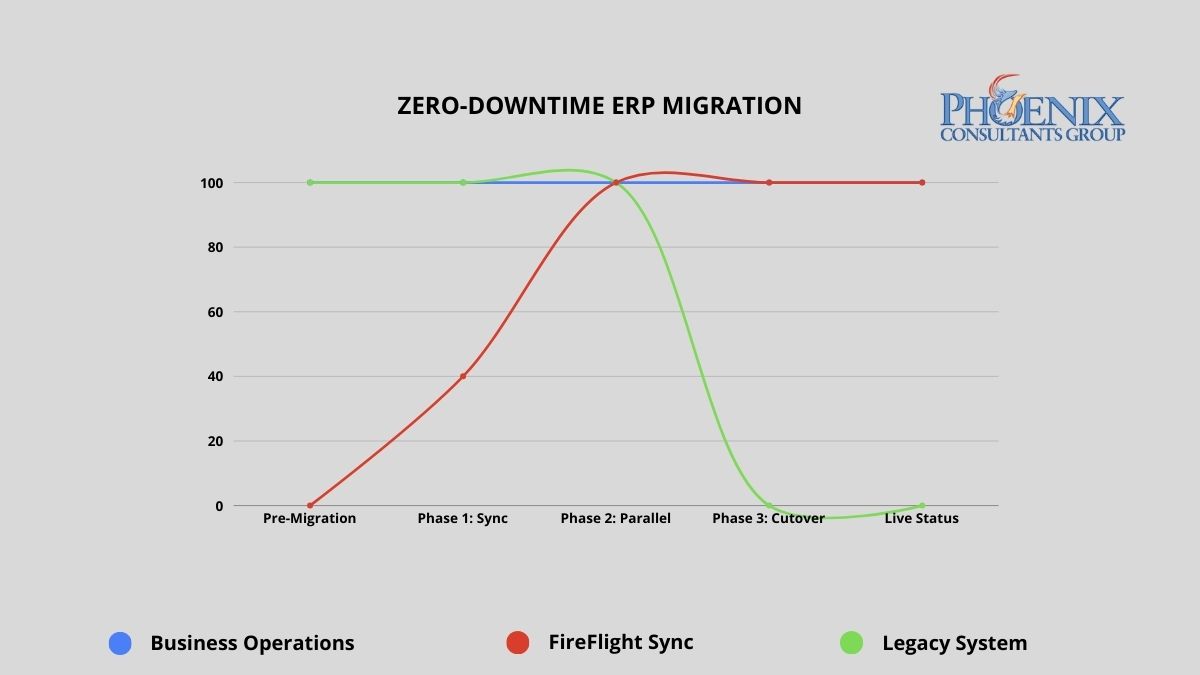
PCG’s parallel deployment model works as follows: FireFlight is built and configured as a complete operational environment for your business including all module configurations, workflow logic, permission structures, and reporting interfaces while your existing system continues running without modification. FireFlight’s data integration layer imports your live operational data continuously during the parallel run, using bulk data migration tools for historical records and real-time or scheduled sync for active transactions. This means that FireFlight is not being tested against synthetic data or anonymized records. It is being validated against your actual business your real orders, your real inventory, your real financial data for weeks before the cutover decision is ever made.
During the parallel run, PCG engineers monitor data accuracy across both systems simultaneously, flagging any discrepancy between what FireFlight records and what the legacy system records in real time. Every edge case in your operational data the unusual transaction types, the legacy data formats, the custom business rules that were never formally documented surfaces during this validation period, where it can be resolved without operational consequence. By the time the cutover decision is presented to your leadership team, the question is not ‘will this work?’ It is ‘we have verified it works are you ready to make it primary?’
The Continuity Roadmap: Three Phases to Zero-Downtime Migration
PCG’s migration methodology is designed around a single constraint: the business does not stop at any point in the process. Every phase is reversible until the final cutover, and the final cutover does not happen until the client and PCG have jointly validated that FireFlight is accurate, stable, and operationally ready.
Data Curation and Foundation Build: PCG extracts your complete data history from the legacy system and performs a full curation process: cleaning inconsistent records, resolving duplicate entries, standardizing data formats, and mapping every data element to the FireFlight architecture. This is not a raw data transfer it is a structured migration that produces a clean, validated opening dataset for FireFlight that is more accurate and more accessible than the legacy records it replaces. The FireFlight environment is built and configured in parallel during this phase, with module logic, workflow rules, and permission structures configured to your specific operational requirements.
Parallel Deployment and Live Validation: FireFlight goes live in shadow mode running in parallel with your legacy system, processing the same live operational data, and allowing your team to interact with and test the new environment without it affecting production. PCG monitors data accuracy between the two systems continuously, with a defined discrepancy resolution process for any variance identified during the parallel run. Your team learns the new interface during this phase, with the legacy system available as a reference and fallback. The parallel deployment phase runs until PCG and your operations leadership jointly confirm that FireFlight has processed a full operational cycle typically 30 to 60 days with documented accuracy at or above the agreed threshold.
The Precision Cutover: Once the parallel validation is complete and both PCG and your leadership team have signed off on FireFlight’s accuracy, the cutover is executed during a scheduled, low-activity window. The legacy system’s master record status is transferred to FireFlight in a controlled, sequenced process. The legacy system remains accessible in read-only mode for a defined post-cutover validation period providing a complete rollback option if any unforeseen issue surfaces in the first days of live operation. In practice, the parallel validation process is thorough enough that post-cutover issues are rare and minor. But the rollback capability exists until your team is fully confident because confidence, not a deadline, is the correct trigger for decommissioning the legacy system.
Evidence of Experience: Zero-Downtime Delivery in High-Stakes Environments
PCG developed the parallel deployment methodology because the Big Bang alternative was generating migration failures that destroyed the value the replacement was supposed to create. Allison Woolbert designed the zero-downtime roadmap after three decades of managing transitions in environments where the margin for operational disruption was zero including mission-critical system migrations for ExxonMobil, Nabisco, and AXA Financial, where a failed cutover carries direct and measurable business consequences.
That zero-tolerance standard for migration downtime is applied directly in PCG’s commercial engagements. In delivering the end-to-end scheduling, credentialing, and payroll system for a multi-facility physician staffing organization an operation that cannot stop processing schedules, cannot lose credentialing records, and cannot delay payroll under any circumstances PCG executed a full system replacement using the parallel deployment model. The client’s operations team interacted with the new FireFlight environment for six weeks before the cutover decision was made. The legacy system went offline on a Sunday morning. By Monday, every facility was fully operational on FireFlight. Zero downtime. Zero data loss. Zero post-cutover rollback required.
Authority FAQ: Migration Risk Objections, Answered Directly
What happens if we find data errors or discrepancies during the parallel validation run?
Discrepancies during parallel validation are expected and manageable that is precisely why the parallel run exists. When PCG’s monitoring identifies a variance between what FireFlight records and what the legacy system records, the discrepancy is classified by type, traced to its source in the data migration or configuration logic, and resolved before the next validation cycle. No cutover decision is made while open discrepancies exist above the agreed accuracy threshold. The parallel validation phase is specifically designed to surface and resolve these issues in a consequence-free environment, so they do not surface for the first time on go-live day.
How long does the complete migration process take from start to go-live?
Total timeline depends on the complexity of your current system, the volume of historical data being migrated, and the number of operational modules being configured. For mid-size operations with 3 to 5 primary system functions and 5 to 10 years of historical data, PCG typically completes the Data Curation and Foundation Build phase in 30 to 45 days, followed by a 30 to 60-day parallel validation run. Total elapsed time from engagement start to cutover is typically 60 to 120 days with the business operating normally throughout.
Can we roll back to the legacy system if something goes wrong after cutover?
Yes, for a defined post-cutover validation period, the legacy system remains accessible in read-only mode and is not decommissioned until PCG and your leadership team jointly confirm that FireFlight is performing as expected under live operational load. The length of the post-cutover validation window is agreed during the project scoping phase and is calibrated to the operational complexity of your business. In practice, the depth of the parallel validation process means that post-cutover rollbacks are not required but the capability is maintained until both parties are fully satisfied, because the correct decommission trigger is confirmed performance, not elapsed time.
What happens to the third-party integrations our legacy system currently supports?
Every third-party integration your legacy system relies on is inventoried during the initial project scoping phase and evaluated individually. Integrations that serve a genuine operational function are rebuilt within FireFlight using clean API architecture eliminating the brittle custom connectors that represent the most common source of Big Bang migration failures. Integrations that were built to compensate for a legacy system limitation are evaluated for elimination: in most cases, FireFlight’s native module library handles the function directly, removing the dependency. No integration goes untested during the parallel validation run every connection is validated against live data before cutover.
How do we manage staff training during the migration without disrupting operations?
The parallel deployment model is inherently a training environment. Your team interacts with FireFlight during the parallel validation phase processing real scenarios, running real reports, testing real workflows while the legacy system remains the operational master. By the time the cutover occurs, your staff has been using FireFlight for 30 to 60 days. The interface is familiar. The workflows are understood. The cutover is not a training event it is a formality following weeks of practical experience with the new system.
About the Author
Allison Woolbert: CEO & Senior Systems Architect, Phoenix Consultants Group
Allison brings over 40 years of expertise in database architecture, enterprise system design, and custom software development. She has spent four decades solving the hardest data problems in business working with Fortune 500 corporations, growing mid-size firms, and small businesses across industries ranging from manufacturing and fleet management to healthcare staffing and regulatory compliance. FireFlight Data System is the product of everything she learned: a purpose-built engine designed to eliminate the structural failures she encountered and fixed throughout her career.