
Spreadsheet Trap: Ending the Manual Workaround Tax
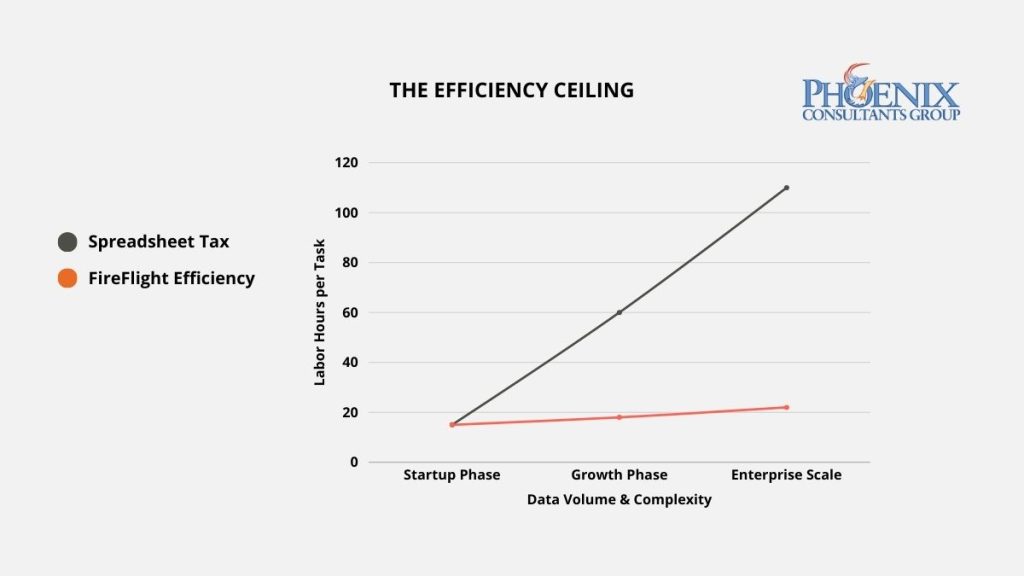
When five employees each spend eight to ten hours per week on manual spreadsheet reconciliation, those hours are not discretionary. They are structural overhead produced by an architecture that cannot close its own gaps. PCG eliminates that overhead by extracting the business logic currently living in your team's spreadsheets and encoding it permanently into FireFlight, where it runs automatically.
Why does fixing data become a full-time job in growing organizations?
Manual workarounds do not appear by accident. They develop at the boundary between what a rigid system can do and what a fluid business process requires. When a legacy ERP cannot handle complex pricing tiers, multi-stage production workflows, or bespoke reporting logic, the team builds the missing capability in Excel because Excel is flexible, immediate, and does not require a development cycle to implement a new formula. This shadow system solves the immediate problem efficiently.
The long-term cost is structural. Because the Excel shadow system exists outside the official database, it has no real-time connection to the operational data it is supposed to reflect. Every time a transaction is processed in the ERP, someone must manually update the spreadsheet. Every time the spreadsheet is updated, there is a window during which the two versions of reality, the ERP's and the spreadsheet's, are out of sync. In high-transaction-volume environments, that window is permanent: the spreadsheet is always catching up to data that moved forward without it. The staff member maintaining it is not performing analysis or strategy. They are performing data maintenance, a full-time job that generates zero operational value beyond keeping a workaround alive that should not exist.
Where does manual workaround time actually go across an organization?
The hours consumed by spreadsheet workarounds are not distributed evenly. The pattern is consistent across organizations: the work is heaviest at the administrative level in raw volume, most consequential at the executive level in opportunity cost, and most persistent at the operations level because reconciliation never fully stops. The table below maps the primary workaround pattern by role and the specific operational impact each one produces.1
| Role Level | Typical Hours Lost Weekly | Primary Workaround Type | Operational Impact |
|---|---|---|---|
| Administrative / Data Entry | 10+ hrs/week | CSV exports, manual re-entry, format conversion | Hours consumed by transfers that should be automatic. Error introduced at every manual step. |
| Middle Management / Operations | 8 hrs/week | Cross-system reconciliation, custom reporting | Operations managers spend their week on data assembly instead of the decisions that data should inform. |
| Executive / Director | 4 hrs/week | Manual data aggregation for strategic decisions | Strategic decision-making delayed by manual aggregation work a live dashboard should handle in seconds. |
| FireFlight Automated System | Under 1 hr/week | Automated validation, sync, and reporting | Every role returns to the work it exists to do. The data pipeline runs without a person inside it. |
The executive row generates the highest opportunity cost because it represents the most consequential misallocation: strategic decision-makers spending four hours per week manually aggregating data that a live dashboard should deliver in seconds. When that time is recaptured, it goes back to analysis, relationships, and decisions. Not to a spreadsheet.
How do I know if my business is already running on spreadsheets as load-bearing infrastructure?
Three operational markers indicate that manual workarounds have become structurally embedded in your business processes, not as temporary fixes but as load-bearing infrastructure. Each carries its own category of compounding risk that grows with organizational size and transaction volume.
The "Master" Spreadsheet
Your business relies on a single centralized Excel file, or a small set of interconnected files, that serves as the operational source of truth for a critical function: pricing, inventory, scheduling, or financial reporting. Only one or two people know how to update it correctly. When that file breaks, the function it supports stops. This is the spreadsheet equivalent of a key-person dependency: a mission-critical system built on infrastructure with no redundancy, no version control, and no audit trail.
The Month-End Exhaustion
Your accounting or operations team works overtime at the end of every month specifically to reconcile data from multiple sources into a coherent financial picture. This overtime is not caused by unusual business volume. It is the predictable cost of an architecture that cannot close its own books. Every month-end reconciliation cycle is a documented measure of how far your system's version of operational reality diverges from what actually happened, and how many hours of skilled labor it takes to bridge that gap manually.
The Format Conversion Loop
Your team's standard workflow includes downloading data from one system as a CSV, reformatting it in Excel, and re-uploading it to another system or using it to populate a report that should be generated automatically. This format conversion loop is data janitorial work: it produces no analytical value, introduces a manual error opportunity at every transfer step, and consumes hours of staff time that could be redirected to the analysis the data is supposed to enable. If it happens weekly, it is a structural problem. If it happens daily, it is a full-time position your architecture has created.
Why does FireFlight eliminate manual workarounds when other ERP systems cannot?
Generic ERP vendors offer macros, integrations, and automation add-ons as premium features. These tools automate individual tasks: a specific export, a scheduled report, a data transfer between two connected systems. They do not address the structural problem. The underlying database logic is still producing data that requires human interpretation and correction before it is useful.
FireFlight automates the logic that generates the data, not just the tasks that move it around afterward. The system handles complex calculations, multi-variable pricing rules, cross-departmental validation logic, and bespoke reporting requirements natively within the system architecture. AI-assisted data entry and field validation prevent incorrect data from entering the system in the first place, eliminating the most common source of the reconciliation errors that drive manual workaround cycles.
For reporting, the function that generates the most intensive spreadsheet dependency in most organizations, FireFlight provides three automation layers. Canned reports cover standard operational metrics without any manual assembly. Filterable ad-hoc reporting tools handle on-demand analysis. User-personalized dashboards assembled from approved query libraries with permission-based visibility controls deliver role-specific views without a manual aggregation step. Export to Excel, CSV, or PDF is available for downstream use cases, but it is a deliberate choice, not a mandatory step in the reporting workflow.
What does the process of replacing spreadsheet workarounds with FireFlight actually look like?
PCG conducts a structured audit of every manual workaround currently active in your organization, documenting each spreadsheet, each format conversion loop, each manual reconciliation step, and the specific business logic embedded in each one. This includes the complex formulas, multi-condition rules, and exception-handling logic your team has built into Excel over years of operational experience. The output is a complete inventory of automation requirements for your FireFlight deployment: every rule that needs to be encoded, every calculation that needs to be automated, and every report that needs to be replaced with a live dashboard equivalent.
PCG engineers extract the business logic from your documented spreadsheets and encode it natively into the FireFlight system, not as a macro or an integration but as first-class system architecture. Complex pricing calculations become automated validation rules. Multi-stage production workflows become system-enforced process flows. Custom reports become live dashboard views with real-time data. PCG validates each encoded rule against the original spreadsheet logic using historical operational data, confirming that FireFlight produces identical outputs to the manual process before the manual process is retired. Your team reviews and approves each automation before it goes live.
Once FireFlight is live and your team has validated the automated outputs against their previous manual processes, the shadow systems are retired. Staff enters data once at the point of origin, and FireFlight executes the downstream logic automatically: the calculations, the cross-departmental updates, the report generation, the exception flagging. The month-end overtime disappears. The master spreadsheet is archived. The format conversion loop is replaced by a live dashboard. Your operations manager goes back to managing operations. Your accountant goes back to financial strategy.
What experience backs the FireFlight automation methodology?
PCG developed FireFlight's automation methodology because the shadow system problem, complex business logic living in spreadsheets outside the official database, was the most common and most costly architectural failure pattern Allison Woolbert encountered across more than four decades of enterprise system work. The pattern appears in every industry, at every company size, in every function: wherever a system cannot handle the complexity of the actual business process, a spreadsheet fills the gap. Wherever a spreadsheet fills the gap, a person's time is consumed maintaining it.
The most direct application of this methodology in PCG's commercial deployments is the end-to-end scheduling, credentialing, and payroll system for a multi-facility physician staffing organization. In that environment, scheduling logic, credential compliance calculations, and payroll rules are among the most complex calculation sets in any industry, and those calculations were previously maintained in a combination of spreadsheets and manual processes across multiple facilities. PCG extracted that logic entirely, encoded it into FireFlight, and delivered a system where scheduling, credentialing, and payroll processing run automatically across all facilities, with the operational team reviewing exceptions rather than building formulas.
1 Weekly hours-lost figures derived from: Smartsheet State of Business Automation Report 2024; Gartner ERP Operational Efficiency Benchmark 2024; validated against PCG client pre-deployment friction assessments, 2021-2025.