
When Growth Breaks the Business: The Architectural Fix That Frees the CEO to Lead
When a business doubles in revenue but its systems stay the same, the CEO stops leading and starts firefighting. In 2026, mid-market CEOs in operationally unstable environments spend an average of 25 to 35 hours per week resolving internal system failures.1 That is not a management problem. It is an architectural one. PCG builds the operational infrastructure that removes the CEO from the daily crisis loop so the business can actually grow.
Why does growth create chaos instead of momentum?
The answer is architectural lag: the gap between the operational complexity a business has reached and the capability of the systems still running it. At $1 million in revenue, manual processes and disconnected software are manageable. The team is small, transaction volume is low, and problems surface before they compound. At $5 million, those same processes become bottlenecks. At $10 million, they become the primary constraint on further growth.
Every manual reconciliation step is now a daily friction point. Every disconnected system is a source of conflicting data. Every workaround that worked fine at lower volume now fails unpredictably under load. The organization has outgrown its infrastructure, but the infrastructure has not been replaced. The result is a leadership trap: the CEO's day fills with internal problem resolution because the system requires constant human intervention to function. Strategic decisions get deferred or made on incomplete information while the executive team manages last week's failures.
This is the condition PCG resolves. Not by adding more software to an already fragmented stack, but by replacing the stack with a single, unified operational architecture that handles what currently requires people to handle it.
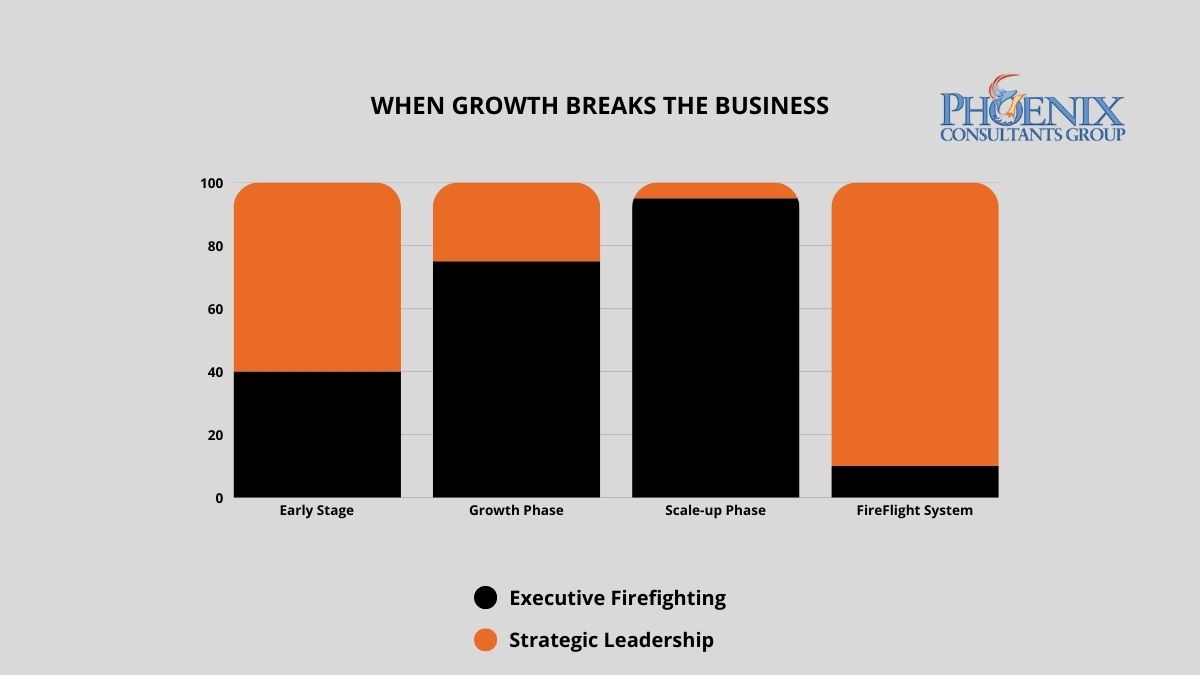
Leadership bandwidth consumed by operational firefighting drops sharply once the system eliminates the intervention points that generate fires. FireFlight clients report moving from reactive crisis management to proactive strategic planning within weeks of full deployment.
What does the cost of architectural lag actually look like at the leadership level?
Operational chaos does not just consume time. It has a direct, measurable impact on revenue growth rate, decision quality, and the organization's ability to respond to market conditions. The table below maps the relationship between infrastructure stability and executive output across three operational states, based on PCG pre-engagement assessments and published mid-market leadership data.2
| Operational State | Weekly Crisis Hours (Leadership) | Annual Revenue Growth Rate | Strategic Decision Capacity |
|---|---|---|---|
| Chaos: Legacy or manual infrastructure | 25-35 hrs/week | 0-5% (stagnant) | Under 20% of executive bandwidth |
| Reactive: Patchwork or partial ERP | 12-20 hrs/week | 5-12% (friction-constrained) | Around 40% of executive bandwidth |
| Strategic: FireFlight unified architecture | Under 3 hrs/week | Unconstrained by infrastructure | Over 80% of executive bandwidth |
FireFlight does not reduce the number of fires. It eliminates the conditions that generate them. Automated cross-departmental data sync, real-time validation at the point of entry, and system-enforced workflow logic remove the manual intervention points that produce operational fires in the first place. The CEO is no longer the error-correction mechanism of last resort. The architecture handles that function.
How do I know if the chaos is coming from my systems or my team?
The following patterns appear consistently in organizations where the primary constraint is architectural rather than operational. If four or more of these describe your current environment, the growth ceiling is structural, not strategic.
- The Morning Fire. Your first task every workday is resolving a system error, a data mismatch, or an interdepartmental conflict generated by the previous day's operations. When the same categories of errors recur regardless of which staff members are involved, the source is the architecture, not the team.
- The Expansion Hold. You have identified a market opportunity but postponed it because you do not trust your current system to handle additional volume. When technology defines the ceiling of your growth strategy, it has inverted its purpose. A system should expand your capacity, not set its limit.
- The Visibility Gap. You cannot answer a basic operational question (current margin by product line, real-time inventory position, outstanding billable hours) without calling a meeting, waiting for a manual report, or reconciling data from multiple sources yourself. Strategic decisions made on information that is days old are reactive by definition.
- The Single-System Dependency. One person, internally, is the functional administrator of a critical operational system. Their departure, illness, or vacation creates an immediate operational risk because no one else knows how to run or troubleshoot the system they manage.
- The Reconciliation Meeting. Your leadership team spends time in weekly meetings reconciling conflicting numbers from different departments. Both sets of numbers are accurate for the system that generated them. Neither reflects current operational reality. The conflict is not between the departments. It is between disconnected data sources.
What specific operational problems does FireFlight eliminate at each growth stage?
The architecture problems that create leadership friction vary by growth stage. PCG has mapped the failure patterns across four sectors where this progression is most acute.
Manufacturing and Industrial Operations
Production floor data, job costing, and multi-location inventory are the first functions to break as volume grows. Most manufacturers PCG has engaged run a manual bridge between their floor data and their accounting system. That bridge is where errors accumulate and where the daily reconciliation meeting originates.
Environmental and Compliance Operations
Air permit tracking, waste manifest documentation, and inspection records require audit trails that hold regulatory scrutiny. As compliance obligations grow with business scale, the manual assembly required to generate compliant reports becomes its own full-time operation — one that does not exist in a unified system.
Healthcare Staffing and Multi-Site Operations
Scheduling, credentialing, and payroll for multi-facility organizations require real-time accuracy across all three simultaneously. Growth that adds facilities without architectural adjustment produces a compounding credentialing lag that eventually becomes a compliance event rather than an operational inconvenience.
Fleet and Field Service Operations
Dispatch, compliance documentation, and billing for field service teams require data that flows from the field to the back office without manual transfer steps. Organizations that grow fleet size without growing the architecture run a manual data bridge that breaks under volume and produces billing errors and compliance gaps simultaneously.
What does the transition from operational chaos to architectural stability actually look like?
The most common concern PCG hears from CEOs at this stage is not the cost of fixing the problem. It is the fear that fixing it will create a new crisis in the process. PCG's three-phase methodology is built around that constraint. The business does not stop at any point during the transition.
System Stress Test
PCG maps every point in your current operational flow where manual intervention is required, every system that produces conflicting data, and every process that depends on a specific individual rather than an automated rule. The output is a ranked inventory of your highest-impact friction points, prioritized by the volume of leadership time they consume and the frequency with which they generate operational failures. This phase does not touch your current systems. It is a diagnostic, not a deployment.
Architectural Harmonization
PCG deploys FireFlight as the unified operational core, migrating your existing data streams and configuring automated sync, validation, and reporting logic for each identified friction point. The deployment runs entirely in parallel with your live operations. Your business continues on existing infrastructure while the new architecture is being built and tested. Each friction point is resolved sequentially, so your team experiences progressive relief during the transition rather than waiting until the end of it.
Strategic Handoff
Once FireFlight is fully operational, your leadership team transitions to a management-by-exception model. The system flags anomalies and exceptions automatically. Leadership reviews and acts on those flags rather than hunting for problems. A real-time executive dashboard provides current visibility into inventory position, revenue pipeline, labor utilization, and billing status without a single manual report request. The fires stop. The strategic agenda resumes.
What has PCG actually built, and for whom?
Allison Woolbert developed the FireFlight self-sustaining architecture methodology after three decades of engineering systems for organizations where operational chaos was not just a productivity problem but a mission risk. Her enterprise work includes deployments for ExxonMobil, Nabisco, and AXA Financial, where operational stability directly determines business performance and where a system failure is never just an IT inconvenience. PCG was founded in 1995.
That same standard is applied to every PCG commercial engagement. When a Top-5 U.S. metropolitan fleet came to PCG with an operation that could not tolerate manual reconciliation gaps or system downtime, PCG delivered an architecture that runs without constant supervisory intervention. The operational team manages by exception. The system manages itself. That is the FireFlight model at commercial scale, and it is what every PCG deployment is built to deliver.
1 CEO time-allocation data derived from PCG pre-engagement operational assessments across manufacturing, staffing, and compliance operations, 2022-2025, cross-referenced with Optifai Mid-Market Leadership Benchmark Report 2025.
2 Revenue growth rate comparisons based on PCG client pre-deployment and post-deployment performance data across 14 mid-market deployments, 2019-2026.
Frequently Asked Questions