
Invisible profit leaks do not appear as single line-item expenses. They accumulate across hundreds of transactions where data moves between disconnected systems and something is dropped, delayed, or never recorded. PCG identifies these hidden loss centers through a forensic Data Integrity Audit, then deploys FireFlight's closed-loop architecture to seal them permanently, so the same categories of loss cannot recur after the system goes live.
Why does margin keep shrinking in businesses where revenue is growing?
Invisible profit leaks are not the result of bad management. They are the structural consequence of fragmented data architecture. When your production floor, warehouse, and accounting department operate on disconnected systems, small discrepancies compound across every transaction cycle. A gap in material waste tracking. A lag in labor capture. A pattern of unrecovered shipping costs. Individually, each sits below the threshold of a typical financial review. Collectively, they represent a consistent, systemic drain on liquidity that no amount of sales growth can fully compensate for.
The core problem is architectural. In a fragmented system, there is no mechanism that closes the loop between what was consumed, what was billed, and what was collected. Transactions flow through the organization across multiple disconnected platforms, and the gaps between those platforms, the moments where data moves from one system to another through a manual step or an informal process, are precisely where the margin disappears. Without a unified framework that tracks every dollar from initial quote to final invoice, the friction tax is not a risk. It is a guarantee.
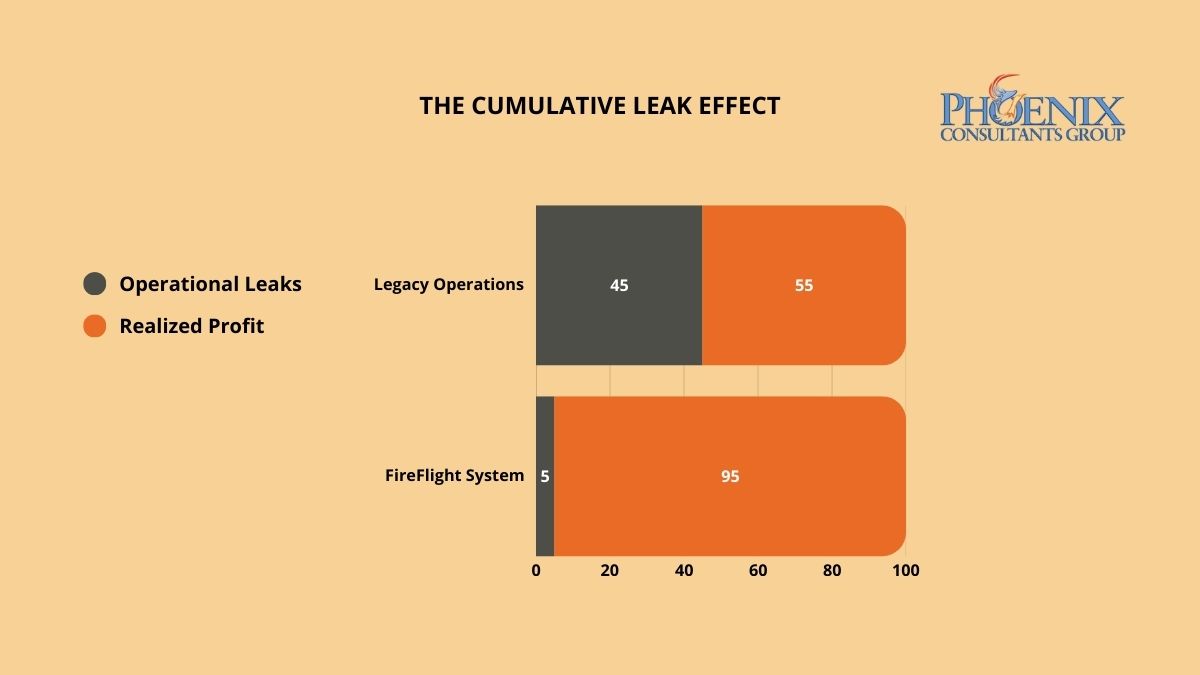
How do I know if the friction tax is actively running in my organization right now?
Three indicators appear consistently in organizations where the friction tax is active. If two or more apply to your current operation, a formal Data Integrity Audit will identify the specific loss centers and the operational gaps generating each one.
The Growing "Miscellaneous" Category
If your year-end adjustments, write-offs, or "other expense" categories are growing faster than your revenue, you are not dealing with isolated accounting anomalies. You are seeing the aggregate of hundreds of small data gaps that your current system cannot capture or categorize. This is the friction tax made visible only at the point of annual reconciliation, when the financial damage has already been done and the operational window to prevent it has long closed.
The Revenue-Labor Mismatch
If your team is logging more hours and production volume is increasing, but net margin is flat or declining, your system is failing to capture the full cost of production and translate it into billable output. This gap between what was consumed and what was invoiced is one of the most common forms of invisible leakage in service-based and manufacturing operations. It compounds silently across every billing cycle until the annual P&L makes the pattern impossible to ignore.
The Unrecovered Cost Pattern
If your shipping, handling, materials, or subcontractor costs are regularly absorbed rather than passed through to the client invoice, your billing process has a structural gap. These costs do not appear as a single failure. They appear as dozens of small line items that were never triggered because the system did not enforce billing completion as a mandatory step in the transaction close. Each individual instance is small enough to overlook. Across a year of transactions at volume, they represent a predictable and recoverable percentage of revenue.
Why does FireFlight stop profit leaks when other ERP systems cannot?
Generic ERP platforms are designed to be flexible, and that flexibility is precisely what creates the leaks. When a system allows manual overrides, optional fields, and informal data entry pathways, it also allows the errors, omissions, and inconsistencies that generate the friction tax. User-friendly input does not guarantee data-accurate output.
PCG engineers FireFlight as a closed-loop integrity engine. The system enforces hard-coded validation rules at the point of data entry, using real-time field validation and contextual error prevention so data is captured correctly the first time, not corrected manually at month-end. Role-based access controls at the form level and subrecord level mean that users can only interact with data they are authorized to modify, eliminating the informal workarounds that create ghost transactions and untracked consumption.
The SQL Server architecture underlying FireFlight is performance-tuned for high-volume transaction environments, with data compression and audit trail logging built into the core framework. Every material movement, every billable hour, and every shipping event is recorded, timestamped, and traceable from the moment it enters the system. There is no gap between operational reality and financial record. The architecture enforces alignment between the two by design, not by policy.
What does the process of identifying and closing profit leaks with FireFlight actually look like?
PCG conducts a forensic analysis of your last twelve months of transactional data, cross-referencing production records, inventory movements, labor logs, and invoicing cycles to identify the specific points where the numbers stop matching operational reality. This audit produces a complete map of your current friction tax: every loss center, the data gap generating it, and the operational pattern that allows it to recur. The audit is completed before a single line of system configuration is written.
PCG configures the FireFlight system to enforce integrity at each identified loss center, deploying automated validation rules, real-time consumption tracking, mandatory billing triggers for unbilled service events, and inventory reconciliation logic that flags discrepancies before they become write-offs. The system is configured to make the correct data entry path the only available path for each high-risk transaction type. Users cannot skip the step that was previously generating the loss.
Once FireFlight is live, your leadership team gains access to a real-time integrity dashboard that tracks margin recapture against the audit baseline. Monthly financial statements reflect the recaptured liquidity directly, with full traceability to the specific architectural changes that prevented each category of loss. The friction tax does not gradually decline. It stops at the point the closed-loop system goes live.
What experience backs the FireFlight closed-loop integrity model?
PCG developed the Data Integrity Audit methodology because financial clarity cannot be achieved through accounting discipline alone. It requires architectural enforcement. Allison Woolbert built this approach after more than four decades of overseeing complex data systems where untracked consumption and unreconciled transactions carried consequences measured in mission success, not just margin points, including enterprise systems for ExxonMobil, Nabisco, and AXA Financial where data accuracy was a non-negotiable operational standard.
That same standard of architectural precision applies to every PCG commercial engagement. In delivering the high-volume fueling system for a Top-5 U.S. metro fleet, an environment where every gallon dispensed must be tracked, authorized, and reconciled against a financial record in real time, PCG engineered the closed-loop integrity model that now underpins the FireFlight system. Zero untracked consumption. Zero reconciliation gaps. Zero friction tax.
Frequently Asked Questions

Every growing business hits this moment: revenue is up, headcount is up, but no one trusts the numbers. Sales has one version of the truth, operations has another, finance has a third, and the CEO is stuck triangulating between spreadsheets, shared drives, and half-updated apps. What used to be “good enough” data becomes a drag […]